
Blog Archives

Pre-Match Offers

I received an urgent request from an applicant last week. He wanted to discuss a pre-match offer he had received that had a Friday deadline. The pre-match program was an academic institution, which was appealing, but the interview day had left the applicant underwhelmed for a number of reasons.

On the one hand, this offer was a sure thing. On the other, the applicant had noted what he considered to be red flags. He asked me what to do.

As usual, in life there is no right answer. But here are a few suggestions if offered a pre-match:

1. Ask for more time. In the worst case scenario, the program director says no. Nothing lost.
2. Try to move up any interviews you have not yet attended.
3. Contact the other program directors and let them know you have a pre-match offer and give them the deadline date. They may offer you a pre-match in return. Or – on the contrary – they may let you know they are not interested. Either would be helpful in making your decision.
4. Speak to residents who are at the pre-match program. Trainees will often readily tell you the weaknesses of their institution :). This information will help you make an informed decision.
5. Assess a) your risk-taking comfort zone and b) the strength of your candidacy. This step is probably the hardest, yet most important.

In the end, the applicant did not accept the pre-match offer and is crossing his fingers he’ll end up at another program he likes better. He is so relieved that – with the information he has now – the decision seems to have been the right one for him.

Tags: , ,

Step 2 CS Changes

In 2004, a team was created to initiate a multi-year, comprehensive review of the USMLE program. This team, called the Composite Committee, is comprised of the Federation of State Medical Boards (FSMB), the National Board of Medical Examiners (NBME), the Educational Commission for Foreign Medical Graduates (ECFMG) and the American public.

Last month this team announced some “enhancements” to Step 2 CS that are scheduled to start the middle of this year. Here is a summary of those changes. Updated practice materials for Step 2 CS will be posted to the USMLE website in March 2012.

Tags: , , , , , ,

Interview Tips from an Entrepreneur

This article is currently at the top of the New York Times’ most emailed list. It’s written for those entering the work force, but it is very pertinent for applicants to medical school, residency, fellowship, and post bacc programs.

I hope everyone has a happy holiday season!

Tags: , , , ,

Happiness: Be All That You Can Be

Medical school and residency training usually decrease one’s happiness for several reasons. Happiness researchers have demonstrated that a feeling of control and the amount of spare time one has both correlate with happiness. Both of those factors are limited during med school and residency. Relationships are also correlated with happiness, and those can be squashed during medical training as well.

I’m not trying to be a downer here! I want to encourage applicants to consider this happiness quotient when selecting an institution and training program. If you are able, maximizing your contentment by choosing an institution that fosters your greatest happiness is key. Geography; proximity to family, friends and community; and a location that provides an opportunity to enjoy hobbies during limited free time is significant.

Excellent training is important, but, in the end, many programs turn out equally qualified clinicians. At least consider your well-being as a factor in selecting where you might be for the next three plus years of your life.

Tags: , , , , ,

Thank You Notes: A Plug for the US Postal Service

I was recently asked by a client about the best way to send post-interview thank you notes – email versus snail mail. This client said he had read conflicting advice online.

As a former Harvard admissions decision-maker who used to receive thank you notes, I can tell you that I strongly advise sending your thank you notes by good old USPS. The reasons are twofold:

1) Email may be viewed as lazy. Hand-written thank you notes take more time, which shows.
2) To put an email thank you note in your file, the receiver needs to take the time to print out your email. You don’t want any barriers between you and your good impression.

I do recommend getting those handwritten thank you notes in quickly. The night after you’ve completed your interview or the next day is a good time to write and send.

Tags: , , , ,

About Dr. Michelle Finkel

Dr. Michelle Finkel

Dr. Finkel is a graduate of Stanford University and Harvard Medical School. On completing her residency at Harvard, she was asked to stay on as faculty at Harvard Medical School and spent five years teaching at the world-renowned Massachusetts General Hospital. She was appointed to the Assistant Residency Director position for the Harvard Affiliated Emergency Medicine Residency where she reviewed countless applications, personal statements and resumes. Read more

Receive FREE Insider Medical Admissions Tips.

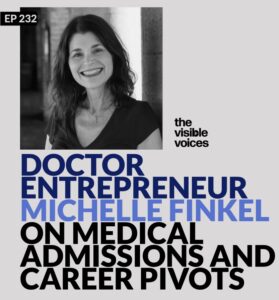
Listen to Dr. Finkel’s interview on The Visible Voices podcast: 


Listen to Dr. Finkel’s interview on the White Coat Investor podcast:

Listen to Dr. Finkel’s interview on the FeminEm podcast: