


The Educational Commission for Foreign Medical Graduates (ECFMG) offers a very cool interactive timeline for the residency application process on the ECFMG website. Here is the link. It’s useful for international/ foreign medical graduates and U.S. medical students as well.
Blog Archives
IMG Performance in the 2013 Match – Good News and Bad News
The good news is that a greater number of IMGs (International Medical Graduates) matched to first-year positions in the 2013 Match compared to last year’s. According to the ECFMG (Educational Commission for Foreign Medical Graduates® ), 6,311 of the 12,683 IMGs who participated matched, which was an increase of 1,425 compared to 2012. The bad news is that that number only translates into 49.8% of IMGs’ matching to first year positions.
Although international medical schools are a good option for some candidates, it is worth noting these numbers if you are a pre-med considering an international school.
For IMGs Participating in the 2014 Match
International Medical Graduates who are planning to participate in this coming year’s match should note that the ECFMG (Educational Commission for Foreign Medical Graduates) ERAS Support Services will not longer accept paper documents. All of an applicant’s supporting documents must be submitted electronically. For more information about how different documents (transcripts, photographs, letters of recommendation) should be submitted, click here.
Step 2 CS Changes
In 2004, a team was created to initiate a multi-year, comprehensive review of the USMLE program. This team, called the Composite Committee, is comprised of the Federation of State Medical Boards (FSMB), the National Board of Medical Examiners (NBME), the Educational Commission for Foreign Medical Graduates (ECFMG) and the American public.
Last month this team announced some “enhancements” to Step 2 CS that are scheduled to start the middle of this year. Here is a summary of those changes. Updated practice materials for Step 2 CS will be posted to the USMLE website in March 2012.
The Residency Match: What Should I Have Done By Now?
Matching to a residency program through the NRMP® (National Resident Matching Program) is a competitive endeavor. Even strong candidates – especially IMGs (international medical graduates) – can have difficulty getting PGY-1 (post graduate year one) positions in many specialties. Those that do match may not get their first or second choices, leaving them in suboptimal locations or programs. It’s important to get started on your application early so you are ahead of the game.
When I was in residency administration, I was impressed with candidates who submitted their applications early. I also had more time to spend on their materials, as I had not yet been inundated with applications, as I would be later in the season.
ERAS® (Electronic Residency Application System) opens July 1 and candidates can assign their materials to specific programs on September 1. Thus, before July I recommend the following:
- Finalize a draft of your personal statement and ERAS activities section.
- If applying in multiple specialties, tailor a separate personal statement for each specialty.
- Contact your Dean’s office (for US students) or ECFMG (Educational Commission for Foreign Medical Graduates) (for IMGs) to ask how to submit your letters of recommendation and photo to them and to get your ERAS token (code to register with ERAS).
- Request all letters of recommendation (excluding your summer rotations). If you are applying in multiple specialties, take advantage of the ability to assign different letters to each program.
- Investigate programs and contact them for special requirements or deadlines.
Getting your application in early can make a difference in how you are perceived by residency directors. To improve your residency candidacy fully, consider working with a professional when it’s time to apply. Because applicants can unknowingly undermine their chances of success with poorly compiled application materials and underdeveloped residency personal statements, a qualified, personalized residency admissions consultant provides a great advantage.
Residency consulting companies come in a variety of forms. Some are bigger businesses that focus on admissions to several types of graduate programs – not just medicine. Others are smaller and provide a medical focus, but have a pool of consultants of varying quality. Finally, elite companies offer both the medical focus and a highly experienced consultant who works one-on-one with clients. These professionals are ex-admissions officers from highly respected medical institutions. They have the inside knowledge of how residency admissions work, providing individualized guidance to optimize applicants’ personal essays, ERAS® and interview skills.
When choosing a residency admissions consulting company, a candidate should verify the company’s references and research its consultants. It is best if the company does not assign written materials to outside editors who cannot be evaluated. Elite companies that offer both the medical focus and a highly experienced consultant who works one-on-one with clients offer a large advantage for applicants, especially during these competitive times.
Tags: Application Materials, Candidacy, Educational Commission For Foreign Medical Graduates, Electronic Residency Application, Electronic Residency Application System, Eras, Foreign Medical Graduates, International Medical Graduates, Letters Of Recommendation, National Resident Matching Program, Personal Statement, Post Graduate, Residency Directors, Residency Match, Residency Program

Dr. Finkel is a graduate of Stanford University and Harvard Medical School. On completing her residency at Harvard, she was asked to stay on as faculty at Harvard Medical School and spent five years teaching at the world-renowned Massachusetts General Hospital. She was appointed to the Assistant Residency Director position for the Harvard Affiliated Emergency Medicine Residency where she reviewed countless applications, personal statements and resumes. Read more
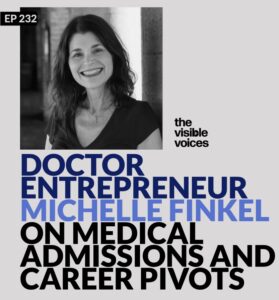
Listen to Dr. Finkel’s interview on The Visible Voices podcast:
Listen to Dr. Finkel’s interview on the White Coat Investor podcast:
Listen to Dr. Finkel’s interview on the FeminEm podcast:
