Blog Archives

Check out these MMI Quick Tips

Although many medical and dental school interviews remain traditional, some institutions utilize a multiple mini interview (MMI) format. The MMI leverages several timed stations to assess applicants’ interpersonal skills and judgment.

A few things to note about MMI interview questions:

1) First, read the school’s description of its format: How many minutes do you have to prepare with the prompt? How long are the stations in total and how many are there?  Should you expect role-play scenarios? Understanding the structure will help decrease stress and improve performance.

2) MMI questions are not always medically-related. You may be asked to manage an everyday problem (e.g. a disagreement at the supermarket). 

3) Schools try to assess whether you can skillfully employ important techniques and demonstrate professionalism. Underlying topics may include your ability to offer effective counseling, understand patient-doctor confidentiality, diffuse a heated situation, or admit wrongdoing.

4) Perhaps most importantly, many MMI queries overlap with “traditional” interview questions. You need to be highly prepared for conventional questions (e.g., What are your three greatest strengths?).

It’s important that you practice thoroughly before your medical or dental school interview. Even if you have excellent social skills, there are techniques you should hone to expertly manage the challenging MMI format. Contact me for personalized practice and guidance.

Tags: , , ,

Grit is Not Enough

University of Pennsylvania professor Angela Duckworth wrote the best-selling book Grit about the power of passion and persistence in predicting success (her TED talk on grit has over 18 million views), but to her credit, she admits to being nearsighted in her new book Situated,which I’m reading now. 

MacArthur “Genius Grant” recipient Duckworth asserts in Situated that your environment – workspace, geographic location, mentors, friends, and even the culture you immerse yourself in— counts as much as (or more than) grit in determining success, and she offers many compelling studies to support her point.

According to Duckworth, instead of focusing on sheer willpower, you should situate yourself among people and in places that make your goals easier and temptations harder.

The book is a good read, and its thesis is worth serious contemplation when deciding where to go to medical school, train, and start your career.

Tags: , , ,

Get y’ERAS in Gear :)

Here’s a quick reminder for residency candidates: Programs can start reviewing ERASes, ResidencyCAS, and MSPEs at 9am EST on September 23. There’s an advantage to submitting your application so it’s in the first batch program directors (PD) see: As one of my PD friends wrote to me, since the residency application is arguably one of the biggest steps in one’s medical career, getting the application in as early as possible should be a given.

(On the other hand, if your application is not in its optimal form, waiting a few days is preferable to submitting an inferior ERAS that will be tossed into the “do not invite” pile.)

Please contact me ASAP for help.

Tags: , , ,

The Number One Strategy for Crushing Medical School and Residency Interviews

Google had a problem. As a 2012 New York Times article described it, Google executives were growing increasingly aware that they were not hiring enough women. Worse still, they were attracting negative attention about it. So, Google did what Google does best: They amassed data and mined it.

In their analysis, among other findings, Google concluded that the company was overlooking women, who tended to be more modest than comparable male applicants during interviews. The interviewers inappropriately perceived the women applicants to be less accomplished, and the candidates were not offered jobs. (Once they understood the problem, Google reported that they altered their internal hiring policies, accordingly.)

No matter what your gender, the story is instructive in understanding how to strategically approach your medical school or residency interview: I call it, Let Your Story Show Your Glory.

Let’s start with this overarching strategy, one that can be gleaned from the Google story: The interview process is a persuasive one. Your role is to convince medical schools or program directors you deserve a slot at their institutions. The best way to persuade is with facts, just like a lawyer does when s/he is trying a case in front of a judge. Saying you are compassionate or hardworking is not convincing, and it doesn’t distinguish you from the scores of other candidates the interviewer is meeting. You need to prove your worth by highlighting your academic, clinical, research, community service, leadership, international, and teaching achievements.

When mentoring applicants, I hear them ask: Michelle, if I showcase my accomplishments in my interview, doesn’t that mean I’m being redundant? My answer: Absolutely! Think of the medical admissions process like building a house. Your AMCAS/ERAS/ResidencyCAS and letters serve as one layer of that house – like scaffolding. In other words, your accomplishments are conveyed simply and succinctly there. The personal statement is your opportunity to apply a thicker layer, one in which you flesh out your achievements, thus persuading the reader of your distinctiveness (plumbing, pipes, electrical). Finally, the interview is your chance to add on the thickest peel (exterior, roof).

Discussing your accomplishments in detail can seal the interviewer’s positive impression of you.

If you still feel shy about drawing attention to your achievements, I can assure you that, occasionally, interviewers do not leave adequate time to review materials for the candidates they will ultimately judge, or they are asked to interview such a large number of applicants that they might understandably get candidates confused. If you treat every interview as though it were a “blind” one, you address these obstacles. Determine in advance how you want your interviewers to remember you when they represent you to the committee, and tailor your interview to leave that impression. At the end of the week, when your interviewer asks what others thought of the “young woman who volunteered with Mother Teresa while doing malaria research and competitive hammer-throwing,” all the other admissions officers will know immediately she is referring to you.

Remember: You can say you are smart or caring or that you want to heal the world, but to admissions committees and program directors, who you are is what you’ve done…and what traits and skills you’ve honed accordingly.

[A version of this blog was previously published on the Varsity Tutors website, where I was part of their Admissions Expert Series.]

Tags: , , ,

Fraud Squad

Earlier this month, the Wall Street Journal published a piece on Cal Tech’s “fraud squad,” a group of four professionals who review admitted students’ credentials to confirm they’re valid. The squad is looking for fabricated extracurriculars, awards, and research, but the WSJ article also mentions concerns about AI use for essays. (I’ll link to the article here, but you’ll need to create a free, temporary account to read the piece.)

I heard an excellent conversation about this topic on the Your College Bound Kid podcast (episode 665), a discussion I’d recommend hearing. Where I differ slightly is that I would suggest avoiding AI even for brainstorming a personal statement. It’s just too easy to go from there to introducing language that is not authentic to the candidate.

Tags: , , ,

About Dr. Michelle Finkel

Dr. Michelle Finkel

Dr. Finkel is a graduate of Stanford University and Harvard Medical School. On completing her residency at Harvard, she was asked to stay on as faculty at Harvard Medical School and spent five years teaching at the world-renowned Massachusetts General Hospital. She was appointed to the Assistant Residency Director position for the Harvard Affiliated Emergency Medicine Residency where she reviewed countless applications, personal statements and resumes. Read more

Receive FREE Insider Medical Admissions Tips.

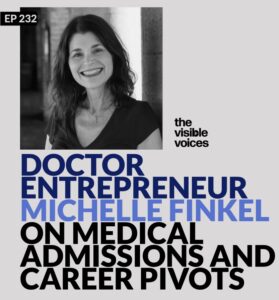
Listen to Dr. Finkel’s interview on The Visible Voices podcast: 


Listen to Dr. Finkel’s interview on the White Coat Investor podcast:

Listen to Dr. Finkel’s interview on the FeminEm podcast: