Blog Archives

What Is the One Thing You’ve Learned…?

I was with my children at a four year-old’s birthday party a few years ago when I met the grandfather of the birthday-boy. As it turned out, before retiring, the man had been on the admissions committee of a prestigious medical school for decades.

So, I asked him, “Looking back at all of those years of experience, what is the one thing you learned from interviewing medical students?”

The man chuckled and said, “They have no idea what they’re getting themselves into.”

In life, we never have any idea what we’re getting ourselves into, but I think of this man every time I practice the question “What will you like least about being a doctor” or “…least about being a [insert your medical specialty here]” with my medical school and residency mentees, respectively. Saying you’ll love everything about being a physician or psychiatrist or pediatrician or internist sounds disingenuous and naive. You need to show that you have some idea what you’re getting yourself into.

Having said that, I would avoid tacky topics like money. And talking about how horrible night shifts are is not going to win you many points. But a sophisticated applicant can infer what the challenges will be in medicine or in her specialty and can express them with aplomb.

…As with everything, practice your answer in advance.

Tags: , ,

Residency and Medical School Applications: Don’t Make It Urgent

I’m writing this blog entry from the Compton, California Jurors’ Waiting Room, having been called for duty today. We were to arrive at 7:45am. After hearing a long introduction from the orientation coordinator here, I noted a woman arriving at 8:50. She sat next to me and asked me to repeat everything the orientation coordinator had said for the last hour.

Her lack of judgment prompted this entry. When approaching your interviews, try to anticipate problem issues and ensure you complete tasks early:

Responding to interview invitations immediately helps you target a time frame you prefer. Also, since some programs do not have enough slots for all of the invitations they issue, it also assures you a slot.

Arriving at your interview early decreases stress, which allows you to perform optimally. At times it also gives you the opportunity to better acquaint yourself with the coordinator or even the residency director. (Several years ago a residency candidate told me he had a fifteen-minute one-on-one conversation with the residency director because the applicant had arrived early. He felt confident that the individualized time furthered his candidacy.)

Sending your thank you notes immediately increases the likelihood they could make a positive impact on your candidacy since faculty may speak about your candidacy earlier rather than later.

So, don’t make it urgent. Plan in advance. If nothing else, the perception of control will help reduce anxiety and improve your interview days.

Tags: , ,

Nailing the Residency or Medical School Interview

Google had a problem.

As a New York Times article describes it, Google executives were growing increasingly aware that they were not hiring enough women. Worse still, they were attracting negative attention about it. So, Google did what Google does best: They amassed data and mined it.

In their analysis, among other findings, Google concluded that the company was overlooking women who tended to be more modest than comparable male applicants during interviews. The interviewers inappropriately perceived the women applicants to be less accomplished, and the female candidates were not offered jobs. (Once they understood the problem, Google altered their internal hiring policies accordingly.)

This story is instructive in understanding the importance of your residency or medical school interview.

Let’s start with your overarching strategy, one that can be gleaned from the Google story: The residency and medical school interview processes are persuasive ones. Your role is to convince faculty that you deserve a slot at their institutions. The best way to persuade is with facts, just like a lawyer does when s/he is trying a case in front of a judge. Saying you are compassionate or hardworking is not convincing, and it doesn’t distinguish you from the scores of other people the interviewer is meeting. You need to prove your worth by highlighting your academic, clinical, research, community service, leadership, international, and/or teaching achievements.

When mentoring applicants, I hear them ask: Michelle, if I showcase my accomplishments in my residency/ medical school interview, doesn’t that mean I’m being redundant? My answer: Absolutely! Think of the medical admissions process like building a house. Your ERAS®/AMCAS® and letters serve as one layer of that house – like scaffolding. In other words, your accomplishments are conveyed simply and succinctly there. The personal statement is your opportunity to apply a thicker layer, one in which you flesh out your achievements, thus persuading the reader of your distinctiveness (plumbing, pipes, electrical). Finally, the interview is your chance to add on the thickest peel (exterior, roof). Discussing your accomplishments in detail can seal the interviewer’s positive impression of you.

If you still feel shy about drawing attention to your achievements, I can assure you that occasionally residency and medical school interviewers do not leave adequate time to review materials for the candidates they will ultimately judge, or they are asked to interview such a large number of applicants that they might understandably get candidates confused. If you treat every residency and medical school interview as though it were a “blind” one, you address these obstacles. Determine in advance how you want your interviewers to remember you when they represent you to the committee, and tailor your interview to leave that impression. At the end of the week, when your interviewer asks what others thought of the “young woman who volunteered with Mother Teresa while doing malaria research and competitive hammer-throwing,” all the other admissions officers know immediately she is referring to you.

Tags: , ,

Medical School and Residency Interviews: Let Your Story Show Your Glory

With medical school and residency interview seasons approaching, it’s critical that you create a strategy to optimally manage the process. Remember that interviews are a persuasive endeavor – not simply a chance to introduce yourself. You need to use examples of your accomplishments to convince the interviewer of your worthiness.

Take a look at this short piece I wrote to get you on the right track fast.

Tags: , ,

Medical School and Residency Interviews: Power Pose

Those of you who have worked with me may recall that I am a big fan of the “fake it until you make it” philosophy espoused by Harvard’s Amy Cuddy. Many applicants are overly humble about their accomplishments, leaving their interviewers mistakenly underwhelmed.

Cuddy’s TED talk has been viewed over 19 million times. It’s definitely worth a watch.

Tags: ,

About Dr. Michelle Finkel

Dr. Michelle Finkel

Dr. Finkel is a graduate of Stanford University and Harvard Medical School. On completing her residency at Harvard, she was asked to stay on as faculty at Harvard Medical School and spent five years teaching at the world-renowned Massachusetts General Hospital. She was appointed to the Assistant Residency Director position for the Harvard Affiliated Emergency Medicine Residency where she reviewed countless applications, personal statements and resumes. Read more

Receive FREE Insider Medical Admissions Tips.

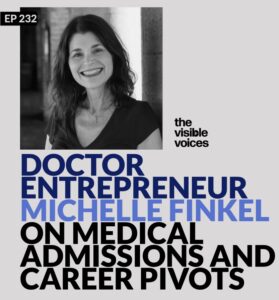
Listen to Dr. Finkel’s interview on The Visible Voices podcast: 


Listen to Dr. Finkel’s interview on the White Coat Investor podcast:

Listen to Dr. Finkel’s interview on the FeminEm podcast: