
Blog Archives

To Address or Not to Address (Deficiencies in Your Application): That is the Question

Whether to address weaknesses in your application during the interview is a difficult topic. Generally, what I recommend is as follows:

1. If you have a mild weakness (one mediocre grade/evaluation), there is no need to bring it up with the interviewer.

2. If, on the other hand, you have a major weakness (very low MCAT/failed the USMLE, large chronological gap, etc.) then you are better off addressing the issue head on. Think of the politicians who are caught in scandals: Those that ‘fess up early manage their problems. Those that don’t let the press interpret them. (I’m not saying that a weakness in one’s application is equivalent to some politicians’ misconduct; I’m just using this as an analogy.) If you have a glaring problem, go ahead and confront it head on. It will demonstrate integrity and will allow you to mold the admission committee’s perception.

For individualized mock interview assistance, contact me. I am booking 2-3 weeks in advance, but I try to squeeze in clients sooner when I’m able.

Tags:

Inquiring About Your Status

Please see my previous blog entry about contacting institutions regarding your status. When you call you can gently say, “I’m attempting to make some travel arrangements and was wondering if you could give me an update on my status.” As long as you are polite, you won’t hurt your candidacy. (Of course, if an institution specifically requests on their website or brochures that you not call, I would advise against it.)

Tags:

Medical Residency Interview Advice

Matching to a residency program through the NRMP® (National Resident Matching Program) is a competitive endeavor. Even strong candidates – especially IMGs (international medical graduates) – can have difficulty getting positions in many specialties. Those that do match may not get their top choices, leaving them in suboptimal programs.

Consequently, optimizing your performance during the medical residency interview is critical. But what are residency directors looking for during the interview process?

First, they are seeking someone distinctive. Your goal is to distinguish yourself from all of the other applicants by showcasing your accomplishments. Anyone can say s/he is compassionate or hard working. Fewer candidates can prove it. Read more ›

Tags: , , , , , , , , , ,

Medical School Competition

United States medical school enrollment is up for the eleventh consecutive year, according to the Association of American Medical Colleges. Check out this short article on the topic.

Tags:

The Early Bird

For all of those pre-med students who are reading my blog in preparation for their future applications to medical school, here’s a reminder: Start early. One of my clients from this application season has already been admitted to two top medical schools. As I’ve mentioned before, medical school admissions are rolling. You can increase your odds by getting your AMCAS in during June and July.

Tags:

About Dr. Michelle Finkel

Dr. Michelle Finkel

Dr. Finkel is a graduate of Stanford University and Harvard Medical School. On completing her residency at Harvard, she was asked to stay on as faculty at Harvard Medical School and spent five years teaching at the world-renowned Massachusetts General Hospital. She was appointed to the Assistant Residency Director position for the Harvard Affiliated Emergency Medicine Residency where she reviewed countless applications, personal statements and resumes. Read more

Receive FREE Insider Medical Admissions Tips.

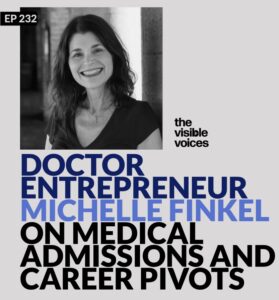
Listen to Dr. Finkel’s interview on The Visible Voices podcast: 


Listen to Dr. Finkel’s interview on the White Coat Investor podcast:

Listen to Dr. Finkel’s interview on the FeminEm podcast: