
Blog Archives

How to Make a List of Programs to Target for Your Medical Residency Application

Because getting into residency continues to get harder each year, the submission of a strong residency application is critical. It’s important too, to ensure you create a realistic list of programs to target. When I review re-applicants’ candidacies to see what went wrong the year before, I oftentimes note that the applicants did not have realistic expectations.

If an applicant’s scores, letters of recommendation and medical school grades are suboptimal, there is little to no chance that person will match into a competitive specialty like dermatology, radiology and ophthalmology. Furthermore, even if an applicant is pursuing a less competitive specialty, the candidate must show early commitment to the field. That could mean research, successful rotations in the specialty and presentations or attendance at national conferences. Too often I see applicants pursue specialties for which their application demonstrates no particular connection. Read more ›

Tags: , , , , , , , ,

How to Make a List of Schools to Target for Your Medical School Application

Because getting into medical school continues to get harder each year, the submission of a strong medical school application is critical. It’s important too, to ensure you create a realistic list of medical schools to target. When I review re-applicants’ candidacies to see what went wrong the year before, I oftentimes note that the students did not have enough schools on their lists and that they did not have realistic expectations.

I recommend starting with the Medical School Admission Requirements (MSAR) book, a guide to United States and Canadian medical schools created by the Association for American Medical Colleges (AAMC). This book offers you hard data about mean grade point averages and average MCAT scores, so that you can ensure you are a competitive candidate before you apply. Read more ›

Tags: , , , , , , , , , , , , , ,

Alternatives to Overscheduling the Doctor

There’s an interesting NYT article on the lack of time doctors have to see their patients and alternative systems to alleviate the problem. These systems may be the wave of the future for physicians.

Tags:

AMCAS: Brevity is the Soul of Wit

The AMCAS application consists of a maximum of fifteen work/activity descriptions, all of which must be maintained within a 1325 character requirement (including spaces). Do not fall into the trap of trying to fill the space. A brief, streamlined AMCAS is much more likely to be read – not scanned.

Imagine yourself as an admissions committee member who has scores – maybe hundreds – of AMCAS to review. You start to review an AMCAS that fills all of the allotted space. You are not going to look upon this favorably! You are seeking well-written, brief summaries of applicants’ accomplishments.

For help with your AMCAS descriptors please contact me. Showcasing your accomplishments optimally is essential.

Tags:

Physician Work Hours – Maybe Not So Bad… Eventually

Check out this comforting article about work-life balance. I’ve only had a label for my posts called “physician dissatisfaction,” but now I’m adding “physician satisfaction.” This article begs the question, though, of how much more competitive medical school admissions will become as bright students flee business.

Tags:

About Dr. Michelle Finkel

Dr. Michelle Finkel

Dr. Finkel is a graduate of Stanford University and Harvard Medical School. On completing her residency at Harvard, she was asked to stay on as faculty at Harvard Medical School and spent five years teaching at the world-renowned Massachusetts General Hospital. She was appointed to the Assistant Residency Director position for the Harvard Affiliated Emergency Medicine Residency where she reviewed countless applications, personal statements and resumes. Read more

Receive FREE Insider Medical Admissions Tips.

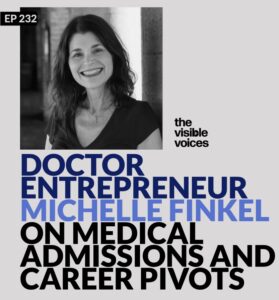
Listen to Dr. Finkel’s interview on The Visible Voices podcast: 


Listen to Dr. Finkel’s interview on the White Coat Investor podcast:

Listen to Dr. Finkel’s interview on the FeminEm podcast: