
Blog Archives

How Do I Strategically Apply in Two Fields?

Occasionally I help residency applicants who are applying in two specialties. This tactic can be strategic in specific scenarios, but it also makes the process more complicated. Here are some quick clarifications to help:

1) Different personal statements can be assigned to different programs. This means you can assign a pediatrics essay to pediatrics programs and an internal medicine essay to internal medicine residencies. Of course, you need to have two versions of your statement, and you need to ensure you assign each correctly.

2) Different letters of recommendation can be assigned to different residency programs as well. (A maximum of four letters may be assigned to each program.) You’ll either need to have letter writers for different fields, letter writers who will craft two types of letters, generic letters (less compelling), or a mix of these approaches.

3) Assuming you are not applying in ob/gyn, EM, or their program variants (which require the ResidencyCAS), you will have one application, and it will go to all of your programs. So, for example, if you flesh out your membership in multiple pediatrics organizations in your ERAS activities, that list will be viewed by your internal medicine readers as well – and might make them question your commitment to IM.

Tags: , , ,

NRMP’s Charting Outcomes 2026 is Out. You Should Read It.

The NRMP just published their Charting Outcomes™: Characteristics of Applicants who Match to Their Preferred Specialty for 2026, data I keep bookmarked because I refer to it so frequently. There are separate reports for US MDs, DOs, and IMGs, and results are further broken down into specialties. Charting Outcomes includes extremely helpful information, including what the median board scores, number of contiguous ranks, and number of research experiences were for those in each specialty who successfully matched – and those who did not.

It’s important to make sure you are in the range for your intended field. (Median Step 2 CK score for successful versus unsuccessful family medicine matchees: 244 versus 230; for dermatology: 258 versus 252.)  Also, make sure to compare the competitiveness of different specialties if you’re seeking to apply in two fields.

Of note, until recently, Charting Outcomes was published every two years, but the NRMP has recently committed to publishing it annually.

Tags: , , ,

The Residency and Medical School Application Process: Moving Past Impostor Syndrome

First described by psychologists Drs. Suzanne Imes and Pauline Rose Clance in the 1970s, impostor syndrome (IS) occurs among high achievers who can’t easily internalize their successes. They often externally attribute their accomplishments to luck and worry others will eventually realize they’re frauds.

Recognize this phenomenon of self-doubt? You’re not alone.

Although many people suffer in silence (because they don’t want their perceived deficiencies revealed), IS is quite common, especially in medical school. According to one often-cited 2016 study by Villwock et al, almost a quarter of male medical students and nearly half of female students surveyed suffered with IS. A 2026 metaanalysis by Abouelmagd et al reported the overall pooled prevalence of IS was 49%. The phenomenon can be associated with depression, burnout, and anxiety. The American Psychological Association offers a few tips for overcoming IS including speaking to mentors, recognizing where you excel, and talking to a professional.

Here’s a fun article on IS by Joelle Borhart MD, the Program Director of the MedStar Georgetown University/Washington Hospital Center Emergency Medicine Residency Program. I also recommend Amy Cuddy’s TED talk with over 77 million views.

Tags: , , ,

“Optional” Secondary Essays: Are They Really?

Optional secondary essays are a conundrum because it’s hard to know if they are truly non-mandatory: Will an institution see a non-response as lazy or truly discretionary?

How to approach these essays depends on two things – the prompt itself and your candidacy.

The beauty of a generic “additional comments” section is that it is intentionally vague. It’s your chance to provide details, context, or qualifications that the structure of the application didn’t allow you to present. For that reason, if you have a candidacy without any red flags, I lean toward using a nonspecific “additional comments” space to both highlight who you are and any exceptional aspects of your candidacy that you’d want a reader to know before making an interview decision. One good option in this circumstance is to pick something completely nonmedical that distinguishes you and is nowhere else to be found in your application. Since an interview isn’t guaranteed, don’t save your best material for an in-person meeting. (On the other hand, if you have a large weakness in your candidacy, you usually want to use an optional, generic prompt or a more focused one to gingerly address the issue. See the next paragraph for guidance.)

Sometimes an optional essay is more pointed. Two cycles ago, an applicant forwarded me this prompt: “Please describe any extenuating circumstances that may have affected your medical or non-medical service experiences, including any circumstances that impacted your engagement in activities, academics, and MCAT that would have helped to prepare you for medical school.” If you have no major deficiencies in your candidacy, there’s no need to write this essay. On the other hand, you should draft a response to this prompt if there’s a big elephant in the room. While, in general, I tell applicants to avoid highlighting standard weaknesses, sometimes someone has a big problem that’s important to address head on. It’s better that you write your own story than let someone else do it.

Bottom line: Optional essays are frequently worth completing because this process is so competitive. And, if you have a big weakness, you should leverage an optional prompt to explain extenuating circumstances.

Tags: , , ,

How Fast Do You Need to Submit Your Secondaries?

I’ve received several questions recently asking in what time frame secondary essays need to be submitted.

Frankly, this is a hard question to answer because the sooner you can get secondaries in, the better, but if you don’t do quality work, you could bomb your candidacy. 

The question reminds me of one I get frequently: What MCAT scores should I target? Well, the higher the better, but there are downsides to fixating on a number. 

So, while you might have heard the popular belief that you must get your secondary applications submitted within two weeks, that’s completely arbitrary. What you want is to do outstanding work as efficiently as possible.

Tags: , , ,

About Dr. Michelle Finkel

Dr. Michelle Finkel

Dr. Finkel is a graduate of Stanford University and Harvard Medical School. On completing her residency at Harvard, she was asked to stay on as faculty at Harvard Medical School and spent five years teaching at the world-renowned Massachusetts General Hospital. She was appointed to the Assistant Residency Director position for the Harvard Affiliated Emergency Medicine Residency where she reviewed countless applications, personal statements and resumes. Read more

Receive FREE Insider Medical Admissions Tips.

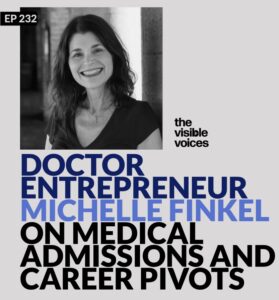
Listen to Dr. Finkel’s interview on The Visible Voices podcast: 


Listen to Dr. Finkel’s interview on the White Coat Investor podcast:

Listen to Dr. Finkel’s interview on the FeminEm podcast: