


The New York Times had a recent, thought-provoking article for perfectionists, overachievers, those with impostor syndrome, and any combination of the above. “Do you Keep a Failure Resume?” is a great reminder that chronicling our failures (something that isn’t encouraged in medicine) can help us determine what the operational roadblocks were to our successes so that we avoid those obstacles in the future. (Perhaps the issue was lack of preparation or speeding through a project unnecessarily.) Reviewed in retrospect, an “anti-portfolio” is also a good reminder that a failure is sometimes the first step to a success in another realm.
Blog Archives
Doctors are Crispy
The annual Medscape Burnout Survey is out and the news this year is – again – somber. More than 15,000 physicians were surveyed in 29 specialties, and 44% of the respondents reported feeling burned out. Urologists made a jump up to the number one burnout specialty with a rate of 54% – with neurologists close behind at 53%. My field of emergency medicine was at 48%, compared to 45% last year. (Click here to see the 2018 Medscape Burnout Survey.) Women are more burned out than men at 50% versus 39%.
For the brave of heart, take a look at all of the 2019 results here.
Tags: Medscape, Physician Burnout
Love Letters
Letters of interest (LOI) – or what some applicants jokingly call “love letters” – can be used in several types of situations:
1) Residency applicants who want to make an impression post-interview before program directors (PD) submit their rank lists
2) Medical school applicants who have been interviewed but have not yet been accepted or rejected
3) Medical school applicants who have not yet been invited to interview (It’s a little late in the cycle now for residency applicants, but LOIs can be used in this way in October through December for residency.)4) Medical school applicants who have been wait listed
When writing your letters of interest, you should have the following goals:
1) Restating your strong interest in the institution
2) Positioning yourself as a distinctive candidate who can contribute fully to the institution
The biggest errors I see in LOIs are:
1) Too much content about a specific institution’s advantages. There is no reason to spend a paragraph or more telling a PD or medical school admissions member what makes their institutions special. Using your precious space this way is an opportunity cost, keeping you from fully showcasing what makes you a compelling applicant.2) Writing about how the program or school will help you. The focus should be on how you will be a contributor to their institution. (It’s the “What have you done for me lately?” principle.)
Finally, let me say that I am coming to think that the term “letter of interest” might be better than “letter of intent” because, generally, I don’t recommend you let institutions know what your intent is since it might change. Note that you can create one general letter that you modify and send to different institutions with different goals (i.e. requesting an interview or demonstrating your interest post-interview). You can also modify the letter and send it to your top choices because, if you are not making commitments, then you can honestly use it for multiple institutions.
For those of you interested in LOI assistance for medical school or residency applicants, please contact me.
Tags: Letter Of Intent, Letter of Interest, Loi
The Rank Order List Deadline Is Approaching: Check Yourself Before You Wreck Yourself
This is an important reminder that Wednesday, February 20 at 9pm EST is the rank order list certification deadline. Start now to think about your priorities and specifically, where you will be happiest. Waiting until the last minute and making impulsive changes to your list is not a great idea.
Please make sure to avoid simple missteps in creating your rank order list. Improving written materials and interview skills is important, but all of that work can go down the drain if applicants do not understand basic strategies for the Match. In November of 2015 the NRMP published an article called, “Understanding the Interview and Ranking Behaviors of Unmatched International Medical Students and Graduates in the 2013 Main Residency Match” in the Journal of Graduate Medical Education. The data is especially important for IMGs who represented the majority of unmatched candidates.
Sadly, the authors found that some applicants made strategic errors including the below:
– Not attending all interviews, thus failing to capitalize on every opportunity to market themselves.
– Declining to rank all programs at which they interviewed or not ranking all programs they would be willing to attend.
– Misunderstanding the Match and ranking programs at which applicants did not interview.
– Failing to rank programs based on true preferences or ranking programs based on the perceived likelihood of matching.
Here is an explanation of the Match algorithm. If you do not understand how the Match works, it is absolutely critical that you learn about it to avoid destructive errors.
Do No Harm
I recommend reading this piece in Emergency Medicine News by Dr. Graham Walker. He writes about a physician colleague who recently committed suicide. The article notes that anesthesiologists and surgeons are the most likely to die by suicide, and emergency physicians come next in the specialties.
As a follow up, this NYT piece on physician suicide is also worth a read – old but still relevant. Sadly, it notes that pre-meds enter medical training with mental health profiles similar to those of their peers but end up experiencing depression at greater rates.
I’ve written about depression in doctors before and would like to reinforce the importance and urgency of seeking professional help for depressed clinicians.

Dr. Finkel is a graduate of Stanford University and Harvard Medical School. On completing her residency at Harvard, she was asked to stay on as faculty at Harvard Medical School and spent five years teaching at the world-renowned Massachusetts General Hospital. She was appointed to the Assistant Residency Director position for the Harvard Affiliated Emergency Medicine Residency where she reviewed countless applications, personal statements and resumes. Read more
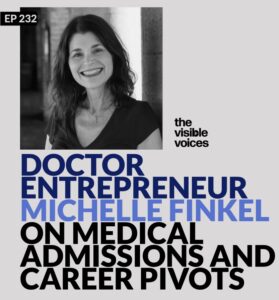
Listen to Dr. Finkel’s interview on The Visible Voices podcast:
Listen to Dr. Finkel’s interview on the White Coat Investor podcast:
Listen to Dr. Finkel’s interview on the FeminEm podcast:
