
Writing Your Own Residency or Medical School Letter of Recommendation: Is it Ethical?

It’s not infrequent that an applicant tells me that a letter of recommendation (LOR) writer has asked the candidate to draft his/her own letter because the writer is “too busy.” I notice that medical school and residency applicants are a bit sheepish as they tell me about this arrangement. Have no fear: You are not doing anything unethical. (Here is an old piece by the New York Times ethicist Ariel Kaminer regarding this exact topic.)

If a faculty member asks you to write your own letter, not only should you do it, but you should do it with zeal. Make sure you showcase the accomplishments that distinguish you from other candidates and highlight traits that are important for your future career path. Use honest – but bold – adjectives to describe your best qualities.

Remember that the letter writer has final say, so even a busy faculty member might modify the letter. Keeping this fact in mind might alleviate your (unnecessary) guilt and should encourage you to write the strongest letter you can. (It’s harder to go from outstanding to mediocre than from outstanding to excellent.)

Tags: , ,

Medical School Help: What are the Next Steps Once the AMCAS is Submitted?

Once your AMCAS is in, what can you do next to best prepare for what’s to come in the medical school admissions process?

Here are a few tips:

1. Start to draft secondary essays. Even if you haven’t yet received the prompts, you can begin to craft responses to common themes like “how would you add diversity to our school?” and “describe an extracurricular activity that might be of interest to the committee.” Good writing takes time, but if you wait for the onslaught of secondary applications, you won’t be able to impart your essays with your highest quality effort.

2. Get a head start on preparing for the medical school interview. Practice, practice, practice. Start mocking up answers to interview questions so that you distinguish yourself.

3. Consider what you want. Do some soul searching to determine what you are really seeking geographically, philosophically, and educationally. You want to make considered decisions when the time comes.

Tags: , ,

A Book that Will Break your Heart and Renew your Commitment to Medicine

This is a stressful time for medical school applicants and residency candidates alike. I recently wrote a piece for Student Doctor Network with five suggested books for training doctors, reads that might relax you a bit while you learn something about your future career. I want to add another recommendation: Paul Kalanithi’s When Breath Becomes Air. Get ready to cry your eyes out, while appreciating beautiful prose and insightful content. Paul Kalanithi was diagnosed with metastatic lung cancer when he was a senior neurosurgery resident at Stanford. He chronicles his short life in a book that’s hard to put down.

Tags: , ,

Insider Medical Admissions Searchable Blogs

Have a specific medical school or residency admissions question? Don’t want to rifle through blog entries individually?

I’ve been writing my blog since 2008 and have a wealth of answers to your questions – all free. But many folks do not know what I have two platforms on which my blog is published.

The first is on my website here. The entries are all tagged, so you can pick a topic and search using that tag.

The second is on Blogger here. This one allows you to search any phrase in the right margin (about a third of the way down the page).

Either way, feel free to use the blogs to get your questions answered easily and quickly.
Tags: , ,

Ten AMCAS Mistakes You Absolutely Want to Avoid

Here’s a quick and dirty list of AMCAS Work and Activities section errors to avoid at all costs:

1. Don’t write to write, and don’t fill to the maximum character count unless necessary. While you want to include many strong achievements, you do not want your AMCAS to be so wordy that your reader is tempted to skim.

2. While you need to be brief, don’t write in phrases; use full sentences. It’s a formal application, and you want to make your written materials as readable as possible.

3. Don’t assume your reader will carefully study the “header” section (including the title of the activity, hours, etc.). Make sure your descriptor could stand alone: Instead of “As an assistant, I conducted experiments…” use “As a research assistant at a Stanford Medical School neuroscience lab, I conducted experiments…”

4. Don’t be vague or trite. Make sure you spell out your accomplishments clearly and substantively. If your reader doesn’t understand an activity, you will not get “full credit” for what you’ve done. Make no assumptions.

5. Avoid abbreviations. Again, you want to be formal, and abbreviations you think are common might not be familiar to the reader.

6. Write about yourself and your role – not an organization. For example, don’t use the space to discuss Doctors without Borders. Use it to discuss the specifics of your role at Doctors without Borders.

7. Avoid generalities and consider using numbers to be persuasive. Saying that the conference you organized had 300 participants says it all.

8. Don’t merge the descriptors with the most meaningful paragraphs because they are separate sections: You can complete descriptors for up to 15 activities with up to 700 characters each plus up to three most meaningful paragraphs of up to 1325 characters each.

9. Unless your PI won the Nobel, avoid using supervisors’ and/or doctors’ names in your descriptors as they will be meaningless to the majority of your readers.

10. Get help. Do not submit your medical school application without having it reviewed. You do not want to showcase suboptimal materials for a process that is this important and competitive.

Tags: , ,

About Dr. Michelle Finkel

Dr. Michelle Finkel

Dr. Finkel is a graduate of Stanford University and Harvard Medical School. On completing her residency at Harvard, she was asked to stay on as faculty at Harvard Medical School and spent five years teaching at the world-renowned Massachusetts General Hospital. She was appointed to the Assistant Residency Director position for the Harvard Affiliated Emergency Medicine Residency where she reviewed countless applications, personal statements and resumes. Read more

Receive FREE Insider Medical Admissions Tips.

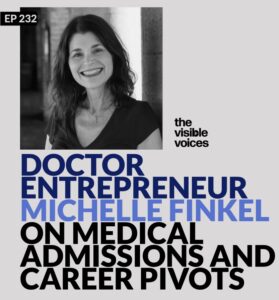
Listen to Dr. Finkel’s interview on The Visible Voices podcast: 


Listen to Dr. Finkel’s interview on the White Coat Investor podcast:

Listen to Dr. Finkel’s interview on the FeminEm podcast: