Blog Archives

Medical School and Residency Interview Practice: Is AI a Good Option?

During the pandemic, I wanted to maintain my Spanish proficiency and improve my facility with the language. A friend recommended a Spanish teacher who lived in Guatemala and offered lessons virtually. I took ten one-hour classes with the tutor, conversing with her throughout the sessions and doing homework in between. She pointed out grammatical mistakes I didn’t know I was making and highlighted subtle country-specific vocabulary. The classes were challenging, but I learned, improved, and felt satisfied after each one.

I tell this story because I recently saw a post in which one student suggested that another use AI for medical school interview practice. Like everything with AI, this approach has benefits and disadvantages.

AI is free and accessible, but it hasn’t been involved in admissions decisions and can’t offer experienced advice. So while AI can suggest endless questions, it can’t provide seasoned, nuanced feedback. AI can also be obsequious. While that might make an applicant feel less anxious about a mock interview, it’s critical to have a veteran interviewer offer strategy and feedback in a kind but effective way, like my Spanish tutor did. 

I recently heard that some people are practicing foreign language conversation with AI. Although Claude is fantastic for other tasks, I’m eager to improve, so I continue to practice with my fluent Spanish-speaking friends and family: I need to challenge myself fully and learn from subtle cues that only an experienced speaker can provide.  

Tags: , , ,

Fraud Squad

Earlier this month, the Wall Street Journal published a piece on Cal Tech’s “fraud squad,” a group of four professionals who review admitted students’ credentials to confirm they’re valid. The squad is looking for fabricated extracurriculars, awards, and research, but the WSJ article also mentions concerns about AI use for essays. (I’ll link to the article here, but you’ll need to create a free, temporary account to read the piece.)

I heard an excellent conversation about this topic on the Your College Bound Kid podcast (episode 665), a discussion I’d recommend hearing. Where I differ slightly is that I would suggest avoiding AI even for brainstorming a personal statement. It’s just too easy to go from there to introducing language that is not authentic to the candidate.

Tags: , , ,

Some Faculty are Using AI to Craft Letters of Recommendation

The AAMC recently published a piece about faculty members who use artificial intelligence to craft first drafts – at least –  of recommendation letters for students. 

I understand the pull of AI for this purpose, but even if the flow and syntax are better, I’m concerned these letters will sound generic and unoriginal. Letters of recommendation can make a huge difference in a student’s candidacy, and submitting something iterative or bland could be a real disservice to the applicant.

The article ends with a quote from a urologist advising that faculty members tell students and the institutions that receive their letters that they use AI to help compose the text, but I would go further and say that if a faculty member is planning to use AI, s/he should tell the student before writing the letter so the applicant can decline the recommendation if s/he wants to.

Let me know if you need assistance with a letter.

Tags: , , ,

The Future Is Now: Using AI to Evaluate Medical School Applicants

The AAMC recently published a piece regarding the use of artificial intelligence (AI) to assess medical school applications: Multiple institutions, including the Zucker School of Medicine and NYU, use AI for initial screening of medical school applications. Others, like the University of Cincinnati College of Medicine and GW, are developing AI capabilities to pilot within the next couple of years.

Admissions officers say the amount of time necessary to review the thousands of applications they receive is overwhelming and that they can teach AI – using years of successful applications to the school – how to effectively assess candidates. Of course, one big downside is that if an AI platform is based on past human decisions, it will inherently propagate and reflect previous biases that produced admissions results.

See the AAMC article here.

Make sure your written materials are the best they can be by being diligent about your process (and by getting professional help).

Tags: , , ,

About Dr. Michelle Finkel

Dr. Michelle Finkel

Dr. Finkel is a graduate of Stanford University and Harvard Medical School. On completing her residency at Harvard, she was asked to stay on as faculty at Harvard Medical School and spent five years teaching at the world-renowned Massachusetts General Hospital. She was appointed to the Assistant Residency Director position for the Harvard Affiliated Emergency Medicine Residency where she reviewed countless applications, personal statements and resumes. Read more

Receive FREE Insider Medical Admissions Tips.

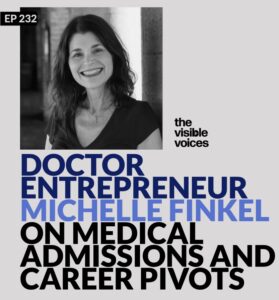
Listen to Dr. Finkel’s interview on The Visible Voices podcast: 


Listen to Dr. Finkel’s interview on the White Coat Investor podcast:

Listen to Dr. Finkel’s interview on the FeminEm podcast: