
Blog Archives

Tomorrow Belongs to Those Who Can Hear it Coming: AMCAS is Opening Next Month

This year’s AMCAS application will open on May 3 at 9:30AM EST, and candidates will be able to submit their AMCAS applications beginning on May 27 at 9:30AM EST. 

Because of rolling admissions, submitting a complete application early in the cycle has distinct advantages at many schools.That doesn’t mean you should submit suboptimal written materials on the twenty-seventh; it means you should start early enough that you are offering your best work.

Rolling admissions means that a school takes applications in the order in which they are received and makes decisions about interviews and then acceptances, accordingly. So, as times goes by, there are fewer interview and admissions offers remaining to be made. Think of an auditorium whose doors open to allow guests in. Those in the front of the line get the seats, and those who come later may not have a chair to sit in. 

If your application is not complete, your candidacy may not be evaluated early when there are more opportunities for interviews and admissions. So, if you have not already, get started immediately. It could make a huge difference in your available opportunities.

Tags: , , ,

Implicit Bias in Medical School Admissions

I participated in a great Harvard Medical School webinar on implicit bias in medicine with cardiologist Dr. Quinn Capers IV, who is a dean at UT Southwestern Medical School. Dr. Capers has published work documenting racial and gender bias in medical school admissions, among other realms. He has also published recommendations on how clinicians and medical educators can mitigate implicit bias in patient care and candidate selection

In the webinar, Dr. Capers covered strategies to reduce or neutralize implicit bias, including 

1. Common identify formation – Ask interviewee questions about interests and activities that you share in common.

2. Perspective taking – Take the perspective of a member of the group against which you have unconscious bias.

3. Consider the opposite – When data seem to point to one conclusion, briefly look for information supporting the opposite conclusion before making a final decision.

4. Counter stereotypical exemplars – Spend time with or focus on individuals you admire from groups against which you have a bias.

Dr. Capers described providing an implicit bias “cheat sheet” that included these strategies to medical school interviewers at The Ohio State College of Medicine, where he previously worked. If you have a chance to hear a lecture by Dr. Capers, make sure to grab the opportunity.

Tags: , , ,

No One Wants to be your Second Choice for the High School Prom

Imagine you’re back in high school, planning to ask a fellow classmate out to the prom. You approach your potential date, “Would you be interested in going with me to the dance? You’re one of my top choices.”

Not very compelling…The same is true for letters of interest: I’ve had several applicants ask me if it’s okay to say that an institution is “one of my top” picks.

Avoid that type of language. Instead you can say something like “I would be thrilled to be at your institution,” or ” I’m confident I can make a positive contribution.” In other words, you can stay honest while not shooting yourself in the foot.

edit letters of interest and have been busy with them of late. Let me know if you need assistance.

Tags: , , ,

Read the Fine Print

Several years ago, a medical school applicant told me the following story:

This pre-med decided to write follow up notes to all the schools at which he had interviewed, usually a very good idea. However, he was upset to receive a brusque note from one of the institutions telling him that a) he should have read their policies; they do not allow post-interview contact and b) he was rejected from the school.

I found the school’s note pretty severe, and I strongly suspect the post-interview contact was not related to his rejection. (As an aside, he successfully and happily matriculated at another school.) But this story is a reminder that it’s important to read institutions’ policies about post-interview contact. Most places welcome written updates, but it’s essential to confirm before you send.

Tags: , , ,

It’s Not Personal

When I was in my second year of medical school, a third-year student came to speak to our class about being on the wards. (The student is now a vice chair in emergency medicine here in California.) He gave an animated talk about how important it was to recognize that when residents, attendings, or nurses hollered at us on our clinical rotations, 99% of the time, it wasn’t personal; they were just experiencing stress associated with patient care. He likened the situation to Boston traffic – how drivers lean on their horns for little cause because they are simply frustrated about their days.

It’s not personal, he said. What great advice.

I say the same to my clients. I’ve had applicants complain that faculty were wholly unprepared – reading their applications for the first time during the interview itself. Remember: It’s not personal. This process is arduous, and most candidates, faculty, deans, and program coordinators are tired and doing their best, especially in a pandemic. When things are rough, give others the benefit of the doubt. It will help you get through this anxiety-producing process with your sanity intact.

Tags: , , ,

About Dr. Michelle Finkel

Dr. Michelle Finkel

Dr. Finkel is a graduate of Stanford University and Harvard Medical School. On completing her residency at Harvard, she was asked to stay on as faculty at Harvard Medical School and spent five years teaching at the world-renowned Massachusetts General Hospital. She was appointed to the Assistant Residency Director position for the Harvard Affiliated Emergency Medicine Residency where she reviewed countless applications, personal statements and resumes. Read more

Receive FREE Insider Medical Admissions Tips.

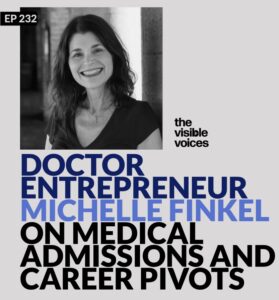
Listen to Dr. Finkel’s interview on The Visible Voices podcast: 


Listen to Dr. Finkel’s interview on the White Coat Investor podcast:

Listen to Dr. Finkel’s interview on the FeminEm podcast: