
Blog Archives

Haven’t Heard Back from a Medical School or Residency Program? Here’s What to Do.

One of the more frustrating aspects of the medical school and residency admissions processes is the lack of response from some institutions. There is no obligation for medical schools or residency programs to reply to a candidate, which leaves applicants in limbo.

If you have not heard back from medical schools or residency programs to which you’ve applied, I recommend that you contact (preferably call) the institutions to inquire about your status.

After I offered that advice to a residency applicant I was advising, she emailed me to say she obtained an interview in a competitive specialty with a phone call. Another said she received two preliminary interviews with simple emails. A third recently told me that, after calling in the morning, he was offered an interview by the afternoon. (Generally, I recommend calls over emails because it’s hard to ignore someone on the other end of a phone line. Still, if you simply can’t bring yourself to call, an email can be effective.)

I’ve seen this phone call strategy work for medical school interviews as well: Several years ago I helped a strong applicant who had been rejected by a top medical school. He thought he was a very good fit for this particular institution, so he called the school to make his case. Shockingly, after the applicant’s phone call, the school granted him an interview, reversing their original rejection. Ultimately, after being initially rejected, this applicant was admitted to that top school. Of course, this is an exceedingly rare occurrence. But to me, the moral of this story is that it is worth being assertive in the application process.Now, if the school or program explicitly asks in written materials that you don’t contact them about your status, then calling is not a good idea, of course.

An additional strong option is to send an effective update letter or letter of recommendation from an influential writer (alumnus, for example). I do edit letters of interest for medical school and residency applicants, but even if you choose not to use my services, I recommend sending a well-written, strategic note in addition to making a phone call.

This process is an uncertain one, but asserting some small bit of control can be useful (and comforting).

Tags: , , ,

ERAS Announces Candidates Can Submit their ERASes without penalty through September 29 at 9am EST

Last week ERAS Communications sent out a notice to candidates that while applicants may certify and submit their MyERASes as early as Wednesday, September 1 at 9 am EST,  applications submitted on or before September 29 at 9 am EST will display an application date of “September 29” to programs. (Applications submitted after September 29 will display the actual application date.) This means that there is no penalty for candidates to wait to submit their applications until the 29th at 9 am EST. This date is considerably later than recent past years.

This is great news for applicants who are still working on their written materials. Use the time to make sure yours are in the best shape possible.

Tags: , , ,

NRMP® Data Suggests Residency Applicants Should Apply Broadly

A few years back, the NRMP published a short document called the Impact of Length of Rank Order List on Main Residency Match Outcome:2002-2016. There, the NRMP reported that matched applicants consistently had longer rank order lists than unmatched applicants.

This data is a bit old, but it assesses over a decade of Matches, so I take it seriously. In my mind, what it means to those approaching the residency application process is that candidates should throw a wide net in choosing programs at which to apply. Of course, there is a financial cost to this strategy, and that expense needs to be balanced. However, according to this data, starting out with more options usually will provide more opportunities to interview and thus, the ability to create a longer rank order list.

Tags: , , ,

Your Residency Application: Being Repetitive Again and Again

In writing their personal statements, many residency applicants ask me, “Isn’t it regurgitating my CV if I highlight my accomplishments?” After all, they say, their achievements have already been noted in the application, MSPE, and letters of recommendation. Think of the residency admissions process as an onion. Your ERAS and letters serve as one layer of that onion, albeit a thin one. In other words, your accomplishments are conveyed simply and succinctly there. The personal statement is your opportunity to apply a thicker layer, one in which you flesh out your achievements, thus persuading the reader of your distinctiveness. Finally, the interview is your chance to add on the thickest peel. Discussing your accomplishments in detail can seal the interviewer’s positive impression of you.

So yes, you are going to be redundant throughout the residency application process, but each part serves a different and additive purpose. If you do not include your achievements in your personal statement, how will you be viewed as distinctive? Remember: Who you are is what you’ve done… and what traits and skills you’ve gained accordingly.

Tags: , ,

The Week I Spent 138 Hours in the Hospital and What it Means for your Residency Application

During my internship, on my surgical rotation, I once spent 138 hours in the hospital in one week. If you think this isn’t mathematically possible, I will tell you that I was on call from Monday morning to Tuesday evening, from Wednesday morning to Thursday evening, in-house on Friday, and then on call from Saturday morning until the next Monday morning. (I had to stay in-house that Monday until evening rounds were over too.) As you can imagine, I was barely human by the end. How this schedule was good for patient care is beyond me.

I thought of that ghastly time recently when reading this oldie-but-goodie article in the New York Times called “How Job Stress Can Age Us” written by Dr. Dhruv Khullar. The author reports on a study, “Physician-Training Stress and Accelerated Cellular Aging” that assessed the DNA of 250 first-year medical residents around the country. Researchers examined the saliva samples of these residents, focusing on their telomeres – the bumpers at chromosome ends that prevent DNA damage – before and after the first year of residency. Researchers found that the DNA of first-year residents aged six times faster than normal.

Six times faster.

I found this both shocking, upsetting, and validating. Residency training is as hard as we think it is. 

What I would strongly recommend is that you compare residency programs’ hours as you decide where to apply and before you create your Match list this coming winter. Strangely, many applicants don’t even consider this important issue when making decisions about their next three to five years. Also, many residencies support physician wellness programs and night coverage. Especially in the setting of severe burnout among doctors, your happiness should be a primary factor in your career choices. If you’re not sure, consider your shrinking telomeres. 

Tags: , , ,

About Dr. Michelle Finkel

Dr. Michelle Finkel

Dr. Finkel is a graduate of Stanford University and Harvard Medical School. On completing her residency at Harvard, she was asked to stay on as faculty at Harvard Medical School and spent five years teaching at the world-renowned Massachusetts General Hospital. She was appointed to the Assistant Residency Director position for the Harvard Affiliated Emergency Medicine Residency where she reviewed countless applications, personal statements and resumes. Read more

Receive FREE Insider Medical Admissions Tips.

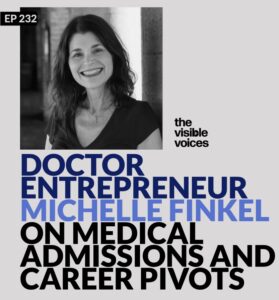
Listen to Dr. Finkel’s interview on The Visible Voices podcast: 


Listen to Dr. Finkel’s interview on the White Coat Investor podcast:

Listen to Dr. Finkel’s interview on the FeminEm podcast: