
Blog Archives

“Optional” Secondary Essays: Are They Really?

Optional secondary essays are a conundrum because it’s hard to know if they are truly non-mandatory: Will an institution see a non-response as lazy or truly discretionary?

How to approach these essays depends on two things – the prompt itself and your candidacy.

The beauty of a generic “additional comments” section is that it is intentionally vague. It’s your chance to provide details, context, or qualifications that the structure of the application didn’t allow you to present. For that reason, if you have a candidacy without any red flags, I lean toward using a nonspecific “additional comments” space to both highlight who you are and any exceptional aspects of your candidacy that you’d want a reader to know before making an interview decision. One good option in this circumstance is to pick something completely nonmedical that distinguishes you and is nowhere else to be found in your application. Since an interview isn’t guaranteed, don’t save your best material for an in-person meeting. (On the other hand, if you have a large weakness in your candidacy, you usually want to use an optional, generic prompt or a more focused one to gingerly address the issue. See the next paragraph for guidance.)

Sometimes an optional essay is more pointed. Two cycles ago, an applicant forwarded me this prompt: “Please describe any extenuating circumstances that may have affected your medical or non-medical service experiences, including any circumstances that impacted your engagement in activities, academics, and MCAT that would have helped to prepare you for medical school.” If you have no major deficiencies in your candidacy, there’s no need to write this essay. On the other hand, you should draft a response to this prompt if there’s a big elephant in the room. While, in general, I tell applicants to avoid highlighting standard weaknesses, sometimes someone has a big problem that’s important to address head on. It’s better that you write your own story than let someone else do it.

Bottom line: Optional essays are frequently worth completing because this process is so competitive. And, if you have a big weakness, you should leverage an optional prompt to explain extenuating circumstances.

Tags: , , ,

How Fast Do You Need to Submit Your Secondaries?

I’ve received several questions recently asking in what time frame secondary essays need to be submitted.

Frankly, this is a hard question to answer because the sooner you can get secondaries in, the better, but if you don’t do quality work, you could bomb your candidacy. 

The question reminds me of one I get frequently: What MCAT scores should I target? Well, the higher the better, but there are downsides to fixating on a number. 

So, while you might have heard the popular belief that you must get your secondary applications submitted within two weeks, that’s completely arbitrary. What you want is to do outstanding work as efficiently as possible.

Tags: , , ,

Secondary Essays: Simply Not Fun

I’ve been getting a ton of questions about secondary essays. As many of you know, I’m not a fan of the entire secondary application requirement. (See my piece, “The Medical School Admissions Process is Falling Short.”) Having said that, most pre-med candidates will have to complete several – if not many – secondary essays and do so on an expedited timeline. 

Secondary essay prompts vary, but there are a few that are standard fare, and one of the most important is “Why do you want to attend our school?” 

Medical school admissions officers want to be assured you know their institution, are seriously considering it, and will fit in well. In approaching the “why-our-school” question, do your research on the institution and link something specific about you with the school’s philosophy, curriculum, patient population, and/or extracurricular programs.For example, if you were a physics teaching assistant in college, you might link your use of the Socratic method with a school’s tutorial-based learning. In that way, you demonstrate knowledge of the school, show you connect well with it, and showcase your distinctive accomplishment.  

The paradox here is that – although you’re focusing your essay on one school – because so many institutions have overlapping philosophies, curricula, programs, and objectives – you can oftentimes use the same framework for many different institutions. That’s one strategic way to cut down the overwhelming workload that secondary applications present.  As you craft your essay, it’s key, however, to know and leverage the names of institution-specific programs like student-run clinics, summer travel scholarships, and/or primary care tracks, for example.

Tags: , , ,

Your AMCAS/ AACOMAS Is In. What Should You Do Now?

Once your AMCAS/AACOMAS is submitted, take a deep breath, relax for a few days, and then start thinking about your secondary essays. 

You can look online to see last year’s prompts and maximum character counts. While there’s no guarantee the prompts will be the same from year to year, the majority of the time they are for an individual school. Here’s a brief blog entry on a common secondary prompt: “Why Our School?”

Also, once the AMCAS/AACOMAS is in, take a moment to do some soul searching about what you’re seeking geographically, philosophically, and educationally. You want to make considered decisions when the time comes.

Finally, you can start practicing for your interviews. Here’s information on my mock interview services.

Tags: , , ,

“Optional” Secondary Essays: Are They Really?

I’ve recently received several questions about optional secondary essays. How to approach these depends on two things – the prompt itself and your candidacy.

The beauty of a generic “additional comments” section is that it is intentionally vague. It’s your chance to provide details, context, or qualifications that the structure of the application didn’t allow you to present. 

For that reason, if you have a candidacy without any red flags, I lean toward using the “additional comments” space to both highlight who you are and any exceptional aspects of your candidacy that you’d want a reader to know before making an interview decision. One good option in this circumstance is to pick something completely nonmedical that distinguishes you and is nowhere else to be found in your application. Since an interview isn’t guaranteed, don’t save your best material for an in-person meeting. (On the other hand, if you have a large weakness in your candidacy, you usually want to use an optional, generic prompt or a more focused one to gingerly address the issue. See the next paragraph for guidance.)

Sometimes an optional essay is more pointed. An applicant recently forwarded me this prompt: Please describe any extenuating circumstances that may have affected your medical or non-medical service experiences, including any circumstances that impacted your engagement in activities, academics, and MCAT that would have helped to prepare you for medical school. If you have no major deficiencies in your candidacy, there’s no need to write this essay. On the other hand, you should draft a response to this prompt if there’s a big elephant in the room. While, in general, I tell applicants to avoid highlighting standard weaknesses, sometimes someone has a big problem that’s important to address head on. It’s better that you write your own story than let someone else do it.

Bottom line: Optional essays are frequently worth completing because this process is so competitive. And, if you have a big weakness, you should leverage an optional prompt to explain extenuating circumstances.

Tags: , , ,

About Dr. Michelle Finkel

Dr. Michelle Finkel

Dr. Finkel is a graduate of Stanford University and Harvard Medical School. On completing her residency at Harvard, she was asked to stay on as faculty at Harvard Medical School and spent five years teaching at the world-renowned Massachusetts General Hospital. She was appointed to the Assistant Residency Director position for the Harvard Affiliated Emergency Medicine Residency where she reviewed countless applications, personal statements and resumes. Read more

Receive FREE Insider Medical Admissions Tips.

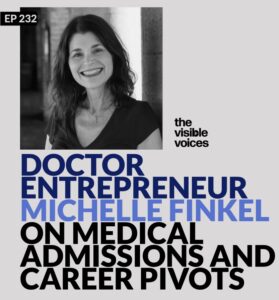
Listen to Dr. Finkel’s interview on The Visible Voices podcast: 


Listen to Dr. Finkel’s interview on the White Coat Investor podcast:

Listen to Dr. Finkel’s interview on the FeminEm podcast: