


This time of year, when the residency and medical school interview processes are in full swing, many of us feel overwhelmed. Here’s a brief but thoughtful piece regarding balance. As you consider your future career, it’s worth thinking about issues the author covers like clarifying what makes you happy and defining balance. In this day and age, one can choose a traditionally tough specialty but work in a practice setting that allows for some autonomy and flexibility. But you need to know what you want to guide yourself in the right direction.
Blog Archives
Your Medical School or Residency Application: What is a Letter of Interest/Intent?
A letter of interest or intent (LOI) is a supplemental note applicants write to medical schools, residencies, and other medical programs to let faculty know of their enthusiasm for an institution and the distinctiveness of their candidacies. LOIs can be written early in an effort to obtain an interview, after the interview to show enthusiasm and to remind the faculty of the candidate’s worthiness, or after a wait list notification (for medical and dental students who don’t participate in the Match).
The letter should be written in a timely fashion. In other words, there’s no reason for a residency applicant to write a letter of intent in late February. The letter should avoid restating the strengths of the institution. Instead the applicant should express his/her interest and then move onto his/her strengths. An LOI should be a page or less.
Please note that some schools and residency programs do not allow post-interview contact, in which case an LOI is not recommended.
For help writing a professional, expert LOI, hire me here.
Your Residency or Medical School Application: More on the Squeaky Wheel
Please see my previous blog entry about contacting institutions regarding your status. When you call you can gently say, “I’m attempting to make some travel arrangements and was wondering if you could give me an update on my status.” As long as you are polite, you won’t hurt your candidacy. (Of course, if an institution specifically requests on their website or brochures that you not call, I would advise against it.)
Your Residency or Medical School Application: Be the Squeaky Wheel
Several years ago I helped a strong applicant who had been rejected by a top medical school. He thought he was a very good fit for this particular institution, so he called the school to make his case. Surprisingly, after the applicant’s phone call, the school granted him an interview, reversing their original rejection.
It was at this time that I met the applicant; we conducted a mock interview so he would be well-prepared.
Ultimately, after being initially rejected, this applicant was admitted to that top school.
Of course, this is an exceedingly rare occurrence. But to me, the moral of this story is that it is worth being assertive (not aggressive!) in the residency or medical school application processes: Send an update letter, call institutions (politely) to inquire about your status (if they do not expressly prohibit phone calls), and be proactive during your interviews. If you haven’t received an interview invitation, now is the time to make a phone call.
You need to advocate for yourself in order to be noticed.
Residency and Medical School Applications: Don’t Make It Urgent
I’m writing this blog entry from the Compton, California Jurors’ Waiting Room, having been called for duty today. We were to arrive at 7:45am. After hearing a long introduction from the orientation coordinator here, I noted a woman arriving at 8:50. She sat next to me and asked me to repeat everything the orientation coordinator had said for the last hour.
Her lack of judgment prompted this entry. When approaching your interviews, try to anticipate problem issues and ensure you complete tasks early:
Responding to interview invitations immediately helps you target a time frame you prefer. Also, since some programs do not have enough slots for all of the invitations they issue, it also assures you a slot.
Arriving at your interview early decreases stress, which allows you to perform optimally. At times it also gives you the opportunity to better acquaint yourself with the coordinator or even the residency director. (Several years ago a residency candidate told me he had a fifteen-minute one-on-one conversation with the residency director because the applicant had arrived early. He felt confident that the individualized time furthered his candidacy.)
Sending your thank you notes immediately increases the likelihood they could make a positive impact on your candidacy since faculty may speak about your candidacy earlier rather than later.
So, don’t make it urgent. Plan in advance. If nothing else, the perception of control will help reduce anxiety and improve your interview days.

Dr. Finkel is a graduate of Stanford University and Harvard Medical School. On completing her residency at Harvard, she was asked to stay on as faculty at Harvard Medical School and spent five years teaching at the world-renowned Massachusetts General Hospital. She was appointed to the Assistant Residency Director position for the Harvard Affiliated Emergency Medicine Residency where she reviewed countless applications, personal statements and resumes. Read more
Listen to Dr. Finkel’s interview on The Visible Voices podcast:
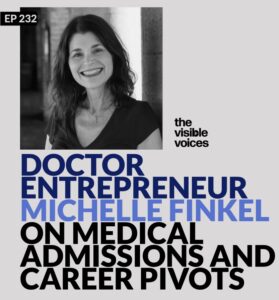
Listen to Dr. Finkel’s interview on the White Coat Investor podcast:
Listen to Dr. Finkel’s interview on the FeminEm podcast:
