Blog Archives

If You Think Your Medical School Application is Expensive…

According to an article in this month’s Annals of Emergency Medicine, the median educational debt for surveyed emergency medicine residents was $212,000, a substantial amount that altered life and career priorities and caused significant stress.

Medical school is not only tough mentally and emotionally, but also it’s a huge financial burden. And the low salary that residents take home only compounds the issue because of the opportunity costs of not having invested starting at a young age.

Although sobering, it’s worth looking at the study and the conclusions drawn.

Tags: , ,

Residency and Medical School Interview Questions: How to Answer that Icky Decade One

“Where do you see yourself in 10 years?” the interviewer asks you, and you squirm…

An influential physician-administrator once complained to me that whenever he asked potential new faculty hires where they saw themselves in a decade they always said they were interested in global health or teaching. “They just say that because it’s sexy,” he remarked. “Many of them have nothing in their C.V.s to bolster their interest in either pursuit.”

When asked where you see yourself in ten years, consider what your accomplishments thus far support to show a clear evolution. This doesn’t mean you’re stuck with what you’ve done even if you didn’t like it. You could point out that having tried myocardial bench research, you realize that your real interest is in clinical investigations of new cardiac markers. Throwing out activities just because they sound appealing doesn’t make you look professional or your candidacy seem well-synthesized. The idea is to have a trajectory that you can back up, defend, and easily justify.

Many medical school applicants say they don’t know what field they want to go into. Of course not! And many residency applicants don’t know if they want to do a fellowship. That’s okay. Again, the point is to focus on your previous strengths and achievements and leverage them.

One more thing: If you are planning to seek mock interview help from me, please do it now. I am booking several weeks in advance.

Tags: , ,

Using Psychology to Further Your Residency or Medical School Application

In my last post, I spoke about the importance of knowing about a school or program in detail in order to show enthusiasm. This entry is a follow-up piece. Being genuinely complimentary (there’s no need to sell yourself down the river being disingenuous) can readily further your candidacy:
There is a psychological principle that asserts that if someone likes you, you tend to like him/her more. So, if I say, “I was just talking to Mike, and he always says the nicest things about you,” you now like Mike more (even though he’s not a real person in this case).

Use this strategy to your advantage. It’s hard to say, “I like you!” in an interview setting. But when speaking about a school or program during interview day, showcase what the institution’s strengths are and specifically, how they apply to you. If the program has a focus on public policy, mention your work with AMSA’s lobbying efforts. If the school is in Utah, note how much you like skiing. Demonstrating interest and zeal can go a long way to leverage simple psychology.
Tags: , ,

Your Residency Application: Know Before You Go

I distinctly remember a very strong candidate whom we considered as a potential emergency medicine resident many years ago. Although multiple faculty members raved about the medical student, one of my colleagues pointed out that the applicant made it clear he did not want to move to Boston. “He wants to stay in California. If he’s not interested in us, why are we interested in him?”

Mathematically speaking, this strategy doesn’t make a lot of sense. Programs should rank strong applicants highly no matter what they believe the candidates’ desires are. (After all, the program may be wrong, and there is little disincentive to go for the gold.) But the point is that it’s critical that you don’t give off signals that you are not interested in the program at which you are interviewing. (If you would rather not Match than be at that residency, you shouldn’t be interviewing there – not a tactic I would generally recommend, however.)

Know the program well and be enthusiastic about its strengths. Every program has something to offer, and you’ll need to learn details of those positive qualities if you want to stay in the running for a spot.

Tags: , ,

Residency and Medical School Interviews: Don’t Be the “Guy with the Tie”

Check out this brand-new Insider Medical Admissions Guru on the Go© under-one-minute, stop-motion video called, “Spiffy Tie for the Dull Guy.” If you’re heading to residency or medical school interviews this season, you’ll want to learn about this effective way to protect your candidacy while you evade the fashion police.

<

Tags: , ,

About Dr. Michelle Finkel

Dr. Michelle Finkel

Dr. Finkel is a graduate of Stanford University and Harvard Medical School. On completing her residency at Harvard, she was asked to stay on as faculty at Harvard Medical School and spent five years teaching at the world-renowned Massachusetts General Hospital. She was appointed to the Assistant Residency Director position for the Harvard Affiliated Emergency Medicine Residency where she reviewed countless applications, personal statements and resumes. Read more

Receive FREE Insider Medical Admissions Tips.

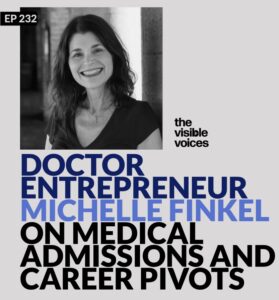
Listen to Dr. Finkel’s interview on The Visible Voices podcast: 


Listen to Dr. Finkel’s interview on the White Coat Investor podcast:

Listen to Dr. Finkel’s interview on the FeminEm podcast: