Blog Archives

Medical School Interviews: Preparing for your MMI

Although the majority of medical school interviews are traditional, an increasing number of medical schools (as well as dental schools) are using the MMI platform. The MMI (multiple mini interview) is a format that uses several timed stations to assess applicants’ interpersonal skills and judgment.
A few things to note about MMI interview questions:
1) They are not always medically-related. You may be asked to manage an everyday problem (e.g. a disagreement at the supermarket).
2) They are not always situational. You need to be prepared for conventional questions too (e.g. what are your three greatest strengths?).
3) Schools are trying to assess whether you can skillfully employ important techniques and demonstrate professionalism. Underlying topics might include your ability to offer effective counseling, your understanding of patient-doctor confidentiality, your ability to diffuse a heated situation, your capacity to admit wrongdoing, etc.
It is important that you practice MMI questions before you go to your medical school interview. Even if you have excellent social skills, there are techniques you should hone to expertly manage the challenging MMI format. Please consider hiring me for a mock interview or two as soon as you get your first interview invitation, as my slots go fast.
Tags: ,

Medical School Interview Tips: What Do Admissions Officers Really Want?

Congrats to those who have already been invited for medical school interviews. It’s early in the season, so if you are an applicant who has not been invited yet, do not dismay.

Getting into medical school has gotten so competitive; the interview is critical. But what are medical schools looking for during the interview process?

1. They are seeking someone distinctive. Your goal is to distinguish yourself from all of the other applicants by showcasing your accomplishments. Anyone can say s/he wants to help people or is hard working. Fewer candidates can prove it with their pre-professional achievements.

2. They want to ensure you are committed to medicine and that you have an idea of what you are getting yourself into. Medical school is tough; the institutions are not seeking someone who is ambivalent and might quit. Giving examples of your clinical experience can help.

3. The schools want to ensure you are reasonable. They want to see that you don’t have a problem personality, aren’t going to harass your colleagues, aren’t going to cause them embarrassment or extra work. Being professional during the interview day and having strong letters are important.

4. They want to hear that you are particularly interested in their institution. You can convince them of your interest by knowing specifics about the school and city.

One would never take the MCAT without practicing first and yet, countless applicants go to medical school interviews without preparing. If you are interested in working with me, please hire me with at least two weeks’ advance, as I’m booking up quickly.

Tags: , ,

The Medical School Interview: Creating your Elevator Pitch

You may have heard the term “elevator pitch,” a streamlined summary a person uses to describe and hopefully, sell her product, service, screenplay, or book. In preparing for medical school interviews, you, too, should create an elevator pitch to sell…you.

Create a 2 to 3 minute “summary statement” that recaps your candidacy, specifically your pre-professional accomplishments and other skills that make you distinctive. (Perhaps you are multilingual, for example.) I’d recommend conceiving of the elevator pitch in chronological order and presenting it that way as well. Doing so makes it easy for you to remember and for the listener to absorb.

Content should include accomplishments in these categories: academic, clinical, leadership, volunteerism, research, teaching, writing, and international work.

If you have this elevator pitch at the tip of your tongue, you’ll be at a great advantage at your medical school interview, ready to nail questions like “Tell me about yourself” and prepared to showcase your accomplishments in other open-ended questions throughout the interview session.

Tags: ,

Residency Personal Statement: Honors Won’t Make it Write

Several years after writing my own residency personal statement, I found myself reading essays and making admissions decisions as a medical school faculty member. In assessing application essays, I learned firsthand that certain personal statement techniques fly and others don’t. A candidate’s approach can mean the difference between acceptance and rejection at his/her dream institution.

The below are some of the most common and easily-avoidable errors applicants make in crafting their personal statements:
1) Unlike mom, an admissions essay reader doesn’t offer unconditional support for an applicant’s endeavors. Candidates who write a paragraph (or two) about their childhood surgeon Halloween costume have made two fatal flaws: First, the tactic is overused. Second, these stories do not engage the admissions reader nor further an applicant’s candidacy because they are not built on evidence of any distinctive accomplishments.

2) The rule applicants should remember is this: All stuff, no fluff. (No Miss America clichés!) The residency personal statement should be a persuasive document that convinces programs that a candidate is worthy of a spot at their institutions, which means it should include facts about what makes an applicant special – her achievements.

Just like a lawyer does when s/he is trying a case in front of a judge, the residency applicant must persuade with evidence. Saying he is a caring person or wants to make the world a better place is not compelling, and those claims do not distinguish the candidate from the scores of other applicants competing with him. The candidate needs to prove his value and distinctiveness with academic, clinical, research, community service, leadership, international, and teaching achievements. To the admissions reader, applicants are what they do – not what they say.

Every part of the personal statement should be distinctive, highlighting unique qualities through accomplishments. If there is even a phrase in the essay that could have been written by someone else, it should be omitted.
3) I remember a talented residency applicant I advised a few years ago who showcased an award she had won. She listed the name, but didn’t explain what it was. When I asked her, she told me the award was an academic honor given to only the top 1% of students out of several thousand. Had she not rewritten the section, her admissions readers wouldn’t have given her an ounce of credit for that extraordinary accomplishment. What a candidate fails to adequately explain counts against her.

Bottom line: Candidates must ensure their residency personal statements can stand alone and don’t rely on the remainder of the application for clarification.

I hope this year’s applicants will leverage the knowledge I’ve offered above to anticipate a future reader’s objections so that they can strengthen their personal statements and reach their career goals.

Tags: , ,

Residency Application: ERAS Tips

I’ve been editing a whole heck of a lot of ERAS applications recently, so I thought I’d create a list of tips for those embarking on their descriptors:

1. Include relevant pre-professional accomplishments from college. If you conducted research, for example, list and describe it. Do not include high school achievements unless they were truly unique (worked at the White House, sang on Broadway ;)).

2. While you want to include many strong achievements, you do not want your ERAS to be so long that your reader is tempted to skim it. Be selective.

3. Keep your descriptors to approximately three to seven sentences. Fewer can look lazy and more can look self-indulgent.

4. Use full sentences. It’s a formal application, and you want to make your written materials as readable as possible.

5. Avoid abbreviations. Again, you want to be formal, and abbreviations you think are common might not be familiar to the reader.

6. Make sure you spell out your accomplishments clearly. If your reader doesn’t understand an activity, you will not get “full credit” for what you’ve done. Make no assumptions.

7. Write about yourself and your role – not an organization. For example, don’t use the space to discuss Physicians without Borders. Use it to discuss the specifics of your role at Physicians without Borders.

8. Use numbers to be persuasive. Saying that the conference you organized had 300 participants says it all.

9. Unless your PI won the Nobel, avoid using supervisors’ and/or doctors’ names in your descriptors as they will be meaningless to the majority of your readers.

10. Get help. Do not submit your residency application without having it reviewed. Don’t submit suboptimal materials for a process that is this important and competitive.

Tags: ,

About Dr. Michelle Finkel

Dr. Michelle Finkel

Dr. Finkel is a graduate of Stanford University and Harvard Medical School. On completing her residency at Harvard, she was asked to stay on as faculty at Harvard Medical School and spent five years teaching at the world-renowned Massachusetts General Hospital. She was appointed to the Assistant Residency Director position for the Harvard Affiliated Emergency Medicine Residency where she reviewed countless applications, personal statements and resumes. Read more

Receive FREE Insider Medical Admissions Tips.

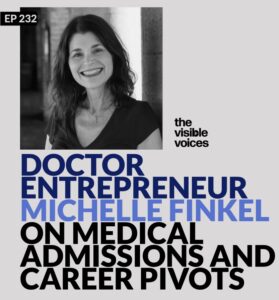
Listen to Dr. Finkel’s interview on The Visible Voices podcast: 


Listen to Dr. Finkel’s interview on the White Coat Investor podcast:

Listen to Dr. Finkel’s interview on the FeminEm podcast: