
Blog Archives

Nailing the Residency or Medical School Interview

Google had a problem.

As a New York Times article describes it, Google executives were growing increasingly aware that they were not hiring enough women. Worse still, they were attracting negative attention about it. So, Google did what Google does best: They amassed data and mined it.

In their analysis, among other findings, Google concluded that the company was overlooking women who tended to be more modest than comparable male applicants during interviews. The interviewers inappropriately perceived the women applicants to be less accomplished, and the female candidates were not offered jobs. (Once they understood the problem, Google altered their internal hiring policies accordingly.)

This story is instructive in understanding the importance of your residency or medical school interview.

Let’s start with your overarching strategy, one that can be gleaned from the Google story: The residency and medical school interview processes are persuasive ones. Your role is to convince faculty that you deserve a slot at their institutions. The best way to persuade is with facts, just like a lawyer does when s/he is trying a case in front of a judge. Saying you are compassionate or hardworking is not convincing, and it doesn’t distinguish you from the scores of other people the interviewer is meeting. You need to prove your worth by highlighting your academic, clinical, research, community service, leadership, international, and/or teaching achievements.

When mentoring applicants, I hear them ask: Michelle, if I showcase my accomplishments in my residency/ medical school interview, doesn’t that mean I’m being redundant? My answer: Absolutely! Think of the medical admissions process like building a house. Your ERAS®/AMCAS® and letters serve as one layer of that house – like scaffolding. In other words, your accomplishments are conveyed simply and succinctly there. The personal statement is your opportunity to apply a thicker layer, one in which you flesh out your achievements, thus persuading the reader of your distinctiveness (plumbing, pipes, electrical). Finally, the interview is your chance to add on the thickest peel (exterior, roof). Discussing your accomplishments in detail can seal the interviewer’s positive impression of you.

If you still feel shy about drawing attention to your achievements, I can assure you that occasionally residency and medical school interviewers do not leave adequate time to review materials for the candidates they will ultimately judge, or they are asked to interview such a large number of applicants that they might understandably get candidates confused. If you treat every residency and medical school interview as though it were a “blind” one, you address these obstacles. Determine in advance how you want your interviewers to remember you when they represent you to the committee, and tailor your interview to leave that impression. At the end of the week, when your interviewer asks what others thought of the “young woman who volunteered with Mother Teresa while doing malaria research and competitive hammer-throwing,” all the other admissions officers know immediately she is referring to you.

Tags: , ,

Medical School Interview Questions: How to Handle the Illegal Ones

In the United States, a professional interview is subject to basic legal rules. Specifically, admissions officers should refrain from asking medical school interview questions that are not relevant to the position the interviewee is seeking. Questions about race, religion, sexual orientation, and marital or family status fall into this category.

If you are asked these types of questions, you can simply answer – if it’s not distasteful to you – or respond by addressing the intent of the question without revealing personal information. (“I think you’re asking if my home life will affect my ability to carry out my medical school studies or my clinical duties. I can assure you it won’t, and I’ll complete my full tenure here at your school.”)

If you have the opportunity to give feedback to the institution about your medical school interview questions or experience, you can consider doing so after the interview. When I was interviewing for residency, I was asked by a faculty member if I had a boyfriend. After the interview day, I talked to a faculty mentor at my school who reported the situation to the other institution. The faculty member who asked me the illegal question was no longer permitted to interview.

Tags: ,

Residency Personal Statement: Should you be a Creative Non-Conformist?

There is no question that being different is an asset in medicine. Those who think outside the box consider diagnoses that others miss, craft approaches to tough patients that others don’t conceive of, and come up with solutions to systemic problems that can positively change medicine as a whole. However, being different does not mean being unprofessional.

Yes, you want to distinguish yourself in your residency personal statement, but you want to do that by showcasing your unique and impressive pre-professional accomplishments, not by submitting a zany essay. Think of it this way: It would be a shame to annihilate your career goal because you’ve made a reader cringe when you were simply trying to write imaginatively.

This is not to say your residency personal statement should be boring! By using good writing techniques – crafting a catchy intro, using robust language, even choosing a compelling sequence – you can write an outstanding essay while still showcasing your accomplishments.

For the skeptic who insists, “Michelle, I’m special. I can do something wild and not scare off the reader,” I will tell you the following anecdote: In all of the time I read essays at Harvard, I remember only one applicant who submitted a truly wacky essay who still received rave reviews. (There was a lively discussion about his weird personal statement, however, before he got the thumbs up.) This person was a true superstar applicant. He came to our program, was loved by patients and staff alike, and eventually became an emergency medicine chief resident. The point of this story? I remember him because he was an outlier – the only applicant in years of assessing candidates whose strange essay did NOT kill his candidacy. Much like CPR, the vast majority of eccentric essay writers don’t respond to heroic efforts to save their candidacy.

Take home point: You get one bullet. Don’t use it to shoot yourself in the foot.

Tags: ,

How to Explain Inconsistencies in Your Medical School Application

You put your heart and soul into your compelling, charismatic medical school personal statement; you showcased your accomplishments and drive to succeed in your activities section; and you demonstrated the endorsement of respected faculty allies in your letters of recommendation. Now your hard work has paid off and helped you get a foot in the door: You’ve been invited to interview at your dream medical school.

But how do you manage the medical school interview when you have a gap in your resume? Let’s say, for argument’s sake, that you took a year off after college and moved to Barcelona to pursue an exciting romantic relationship, only to find yourself dumped two months later. You moped the rest of the year and had neither research nor volunteer experiences to show for your time off. Your interviewer asks you that dreaded medical school interview question: What exactly did you do, anyway, during the gap year?

A prepared candidate can see this interview question as an opportunity to turn a skeptic into an ally. Responding with a calm demeanor – without making excuses or delving into the intricacies of your personal life – will make you look professional. This is a great time to explain that, although you graduated college with a minimum of life experiences, your year off helped you consider alternative professional paths and strengthened your resolve to enter medicine. Consequently, you will pursue your medical career with greater maturity and commitment and a broader perspective than those who went straight through.

The medical school interview requires preparation and an optimistic attitude. Support your candidacy with practice and enthusiasm.

Tags: ,

Managing Difficult Medical School Interview Questions: Rehearse Your Elevator Pitch Now

An important key to preparing for tough medical school interview questions is realizing that a) interviewing is a skill and b) practice improves performance. Every year too many medical school (and residency, fellowship, and dental school) candidates expend tremendous energy assembling fantastic applications, only to undermine their chances by approaching the interview with twisted laws of entropy and enthalpy: They prepare for it with maximum randomness and minimum energy.

Once you’ve done adequate groundwork, the medical school interview represents your opportunity to distinguish yourself and impress your interviewers as the type of candidate they’d love to have at their institution.

That’s not to say every interview will be full of hugs and puppy kisses. Like the story of the interviewer whose window was nailed shut, there may be uncomfortable moments and even illegal questions. With a bit of preparation, you can learn to hit these curveball questions out of the park. Let’s explore an example that has come up in the not-so-distant past.

Rehearse Your Elevator Pitch

While most interviewers take the time to read your application materials in advance, don’t be offended by the faculty member who did not prepare, is blankly flipping through your application right there in front of you, and who asks open-ended (and dreaded) medical school interview questions, such as “Tell me about yourself” to be brought up to speed. View it this way: These faculty members are offering you the opportunity to define how you’d like to be remembered.

Your goal should be twofold: 1) to persuade them how much you’d add to their institution and 2) to make their job easier by giving them the bullet points they’ll need to persuade their peers about your candidacy’s worthiness. When your interviewer sits around a table advocating on your behalf, steer her to use terms that will be germane to your candidacy. Are you the, “global health advocate who volunteered with Mother Teresa and ran his school’s homeless food program?” Or perhaps you are the “first generation college graduate who held premier leadership positions in medical school?” Help your interviewer help you.

In the end, difficult interview questions are less intimidating if you both prepare well and have an attitude that they are an opportunity to clarify and further your candidacy.

Tags: , , , ,

About Dr. Michelle Finkel

Dr. Michelle Finkel

Dr. Finkel is a graduate of Stanford University and Harvard Medical School. On completing her residency at Harvard, she was asked to stay on as faculty at Harvard Medical School and spent five years teaching at the world-renowned Massachusetts General Hospital. She was appointed to the Assistant Residency Director position for the Harvard Affiliated Emergency Medicine Residency where she reviewed countless applications, personal statements and resumes. Read more

Receive FREE Insider Medical Admissions Tips.

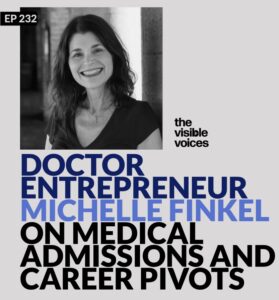
Listen to Dr. Finkel’s interview on The Visible Voices podcast: 


Listen to Dr. Finkel’s interview on the White Coat Investor podcast:

Listen to Dr. Finkel’s interview on the FeminEm podcast: