
Blog Archives

Medical School Letters of Recommendation: Asking the right people 

For those applying to medical school this cycle, if you haven’t already, it’s time to start asking for letters of recommendation (LOR).

Beyond simply fulfilling requirements, you want to get the strongest letters you possibly can from the most influential writers. Choosing the right individuals can be a challenge, and advisees often ask me what to look for in a letter writer. Here is my suggested wish list for potential letter-writers:

1. Explicitly state they will write you a strong LOR

2. Senior faculty

3. Weighty academic titles
4. Well known in their field
5. Spent significant time with you
6. Experienced letter-writers

Of course, all of these qualifications are not possible for all writers. But the more of these you can garner the better. 

With regard to #1, don’t be afraid to ask a potential letter-writer if she will write you “a very strong” LOR. It may seem awkward at the time you ask, but, believe me, getting a wimpy letter will be much thornier. If the faculty member says no, hesitates, or tells you in March that she has to plan her Thanksgiving get-together ;), politely thank her and move on. Although disappointing, acknowledge that she has done you a huge favor. You are far better off avoiding her letter, and you now have the advantage of substituting a stronger LOR written by someone who loves you.

With regard to #2 through 4, admissions officers are human just like the rest of us: Receiving a LOR from an accomplished, known colleague will be weighed much more heavily than one from someone deemed less successful and unfamiliar. If you are better connected to someone without a title, consider asking the professor (a more senior person who has a weightier title) if she would consider writing the LOR with significant input from your closer contact (i.e., the TA who taught your section, or the postdoctoral fellow who directly supervised your research project). That way you get a LOR that includes insight from someone who knows you, signed by a name that packs a punch.

Tags: , , ,

Fee Assistance Program

As the 2021-22 medical school application process ramps up, I want to remind candidates about the Association of American Medical Colleges’ (AAMC) Fee Assistance Program (FAP) and Insider Medical Admissions’ available discount for those with a current FAP. The FAP is designed to offer help to individuals with financial limitations who cannot pay the MCAT registration or AMCAS application fees without financial support.

If you think you are eligible, it’s worth applying for an FAP grant early: If an applicant submits his/her AMCAS prior to receiving a decision on his/her FAP application, that candidate will be ineligible to receive the FAP for the AMCAS. In other words, the candidate will not receive a refund.

For more information on the FAP, please click here. I offer reduced rates for applicants demonstrating financial hardship through a current AAMC FAP grant. After researching the issue, I believe Insider is the only medical consulting company that currently supports a discount for FAP grant recipients. (I apologize if I’m missing a company.) Once you have been granted the FAP and thus, can prove receipt, please feel free to contact me for more information.

Tags: , , ,

Final Tips for Making Your Match List

Applicants must have their rank order lists certified by 9 pm EST this Wednesday (March 2). As I’ve mentioned in a previous post, the algorithm for the Match is relatively simple.

The bottom line:

1. Rank programs so they represent your true preferences. Your first choice should be first. Your second should be second and so on. Do not try to “outthink” the system, as it will only be to your disadvantage.

2. Because of the way the Match algorithm works, what programs think of you (or what you think they think of you) should have zero bearing on how you make your rank order list.

3. Except in highly usual situations, rank all programs at which you interviewed. If you would truly rather not match than be at a specific program, then that program should not be on your Match list; however, do think carefully about the prospect of not matching, entering SOAP, and possibly having to reapply next year.

4. Prioritize your happiness.

Tags: , , ,

Medscape’s National Physician Burnout Report 2021 is out – and it’s Troubling

The Medscape National Physician Burnout & Suicide Report 2021 is now available, and it seems rather evident that the pandemic has negatively affected physicians who were already under a lot of stress, especially those in critical care medicine.

More than half of critical care physicians report being burned out (51%), and critical care ranks as the highest specialty in the burnout questionnaire, followed by rheumatology (50%) and infectious disease (49%). Those numbers compare with last year’s report at 44%, 46%, and 45%, respectively. This year, my field of emergency medicine (EM) was at 44%, which sounds high, but, sadly, EM was not even in the top ten burned out specialties. That gives you an idea of the severe scope of the problem.

Women reported burnout at 51% compared to 36% for men, and while this disparity has been present for many years, the discrepancy between the genders was greater in this most recent report.

Seventy-nine percent of those surveyed relayed that their burnout started before COVID, while 21% reported after. Bureaucratic tasks and too many hours at work were the major reported contributors to burnout.

Take a look at the Medscape National Physician Burnout & Suicide Report 2021 slide deck yourself for more interesting details, and check out my Kevin MD piece on EM burnout here.

Tags: , , ,

Pre-Med? Avoid a Big Mistake

Several years ago I was hired by a re-applicant who wanted to better understand why she did not get into medical school the prior year. She had a 3.9 GPA and a 40 on her MCAT (100% percentile). Yet, she had been rejected from all medical schools.

I looked through her materials and discovered the problem. The applicant had no clinical work at all. She had never been in the room with a patient. Many of you know that I like the saying, “No one wants to hire a chef who hasn’t been in the kitchen.” She had fallen prey to that adage.

We talked, and I advised her regarding options she had for obtaining clinical experience. Fast forward a year: The client completed a robust clinical activity and was readily accepted to medical school (and felt more confident about her career choice).

If you are a pre-med, note that robust clinical experience is critical. Working as an EMT, in a good clinical care extender program, formally as a scribe (where you can also make some money), in a hospice setting, or in a low-income clinic are just some ideas for obtaining excellent clinical exposure. (Although you might think free clinics would be thrilled to have a pre-med volunteer, many understandably require one-year commitments.) 

Shadowing is a mixed bag: Medical schools don’t know whether you’re second-assisting in the operating room or just standing in a corner being ignored. If you choose to shadow, make sure that – in your written materials – you highlight any substantive clinical skills gained. Other popular options for clinical experience include international work (although the activity is usually short-lived, which makes it less robust) and working as a volunteer in a hospital (although it might be more clerical than clinical, depending on the position; thus, the benefit of clinical care extender programs. Do your research before accepting a volunteer hospital job). I’ve also had advisees who became certified, practicing phlebotomists and others who worked in veterinarians’ offices to obtain procedural skills.

More important than getting into medical school (gasp), getting robust clinical experience will help you ensure you’ve made the right career choice. Simultaneously, you’ll demonstrate to admissions officers that you can handle the heat.

See the short video below on the importance of clinical experience:

Tags: , , ,

About Dr. Michelle Finkel

Dr. Michelle Finkel

Dr. Finkel is a graduate of Stanford University and Harvard Medical School. On completing her residency at Harvard, she was asked to stay on as faculty at Harvard Medical School and spent five years teaching at the world-renowned Massachusetts General Hospital. She was appointed to the Assistant Residency Director position for the Harvard Affiliated Emergency Medicine Residency where she reviewed countless applications, personal statements and resumes. Read more

Receive FREE Insider Medical Admissions Tips.

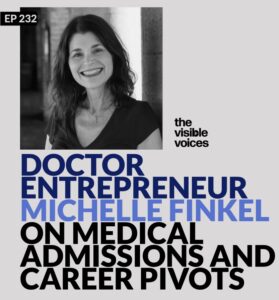
Listen to Dr. Finkel’s interview on The Visible Voices podcast: 


Listen to Dr. Finkel’s interview on the White Coat Investor podcast:

Listen to Dr. Finkel’s interview on the FeminEm podcast: