


Applicants, secondary to very high demand this summer, I am currently booking 2 to 3 weeks in advance for Strategy Sessions and Mock Interviews. If you are in need of an upcoming Strategy Session or Mock Interview, please make sure to hire me at your earliest convenience to secure a slot.
Blog Archives
Secondary Essays: Why Do You Want to Attend Our School?
Secondary essay prompts vary, but there are a few that are standard fare. “Why do you want to attend our school?” is a common topic pre-meds will encounter.
Medical school admissions officers want to be assured that you know their institution, are seriously considering it, and will fit in well there. In approaching the “why-our-school” question, do your research on the institution and link something specific about you with the school’s philosophy, curriculum, surrounding patient population, and/or extracurricular programs.
For instance, if you were a teaching assistant for chemistry in college, you might link your use of the Socratic method with a school’s tutorial-based learning. In that way, you demonstrate knowledge of the school, show that you connect well with it, and showcase your accomplishment.
ERAS Tips for Your Residency Application
I’ve been starting to edit ERASes already, so I thought I’d create a list of tips for those embarking on their descriptors:
1. Include relevant pre-professional accomplishments from college. If you conducted research, for example, list and describe it. Do not include high school achievements unless they were truly unique (worked at the White House, sang on Broadway ;)).
2. While you want to include many strong achievements, you do not want your ERAS to be so long that your reader is tempted to skim it. Be selective.
3. Keep your descriptors to approximately three to seven sentences. Fewer can look lazy and more can look self-indulgent.
4. Use full sentences. It’s a formal application, and you want to make your written materials as readable as possible.
5. Avoid abbreviations. Again, you want to be formal, and abbreviations you think are common might not be familiar to the reader.
6. Make sure you spell out your accomplishments clearly. If your reader doesn’t understand an activity, you will not get “full credit” for what you’ve done. Make no assumptions.
7. Write about yourself and your role – not an organization. For example, don’t use the space to discuss Physicians without Borders. Use it to discuss the specifics of your role at Physicians without Borders.
8. Use numbers to be persuasive. Saying that the conference you organized had 300 participants says it all.
9. Unless your PI won the Nobel, avoid using supervisors’ and/or doctors’ names in your descriptors as they will be meaningless to the majority of your readers.
10. Get help. Do not submit your residency application without having it reviewed. Don’t submit suboptimal materials for a process that is this important and competitive.
ERAS: How Important is it to Submit on the Early Side?
On July 5, DO applicants can start applying to AOA-accredited residency programs, so I’ve had a lot of clients ask me about the importance of getting their ERASes in now. This topic is relevant for MD candidates whose submission date is in early September. These are my thoughts:
1. Yes, getting your ERAS in early helps. At the beginning of the season there aren’t as many ERASes to review so, as a former Assistant Residency Director, I recall giving more time and attention to the early applications. I was also impressed by students who could get their materials in promptly.
2. On the other hand, if your application is not in its best shape then submitting early is a mistake. Waiting a week or two is absolutely preferable to submitting a suboptimal ERAS that will be tossed into the “do not invite” pile. Importantly, all osteopathic residency applicants who apply between July 6 and the 14th will display with a July 15 applied date anyway!
Don’t Let ERAS Kick Y’ERAS
Just a reminder to residency applicants: MyERAS is open and available for you. Even if you aren’t ready to start working on your application (and if you know what field you are applying in, there’s no reason that you can’t be ready right now), I’d recommend registering and taking a look at what will be required of you on the ERAS. Many applicants have never seen an ERAS and don’t know much about what extras are required (like “other awards” and additional unexpected sections).
Don’t be surprised by what’s required of you later in the season… You really cannot start too soon.

Dr. Finkel is a graduate of Stanford University and Harvard Medical School. On completing her residency at Harvard, she was asked to stay on as faculty at Harvard Medical School and spent five years teaching at the world-renowned Massachusetts General Hospital. She was appointed to the Assistant Residency Director position for the Harvard Affiliated Emergency Medicine Residency where she reviewed countless applications, personal statements and resumes. Read more
Listen to Dr. Finkel’s interview on The Visible Voices podcast:
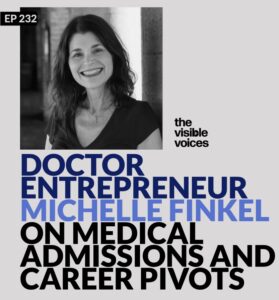
Listen to Dr. Finkel’s interview on the White Coat Investor podcast:
Listen to Dr. Finkel’s interview on the FeminEm podcast:
