Blog Archives

We Need to Decrease the Stress and Inefficiencies Associated with the Residency Application Process

Inefficiencies in the residency application system have been a problem for many years. While the AAMC and NRMP have made efforts to improve the process, including the move from the Scramble to SOAP a few years back, the lack of adequate slots for a large number of candidates leads to a tremendous amount of unnecessary stress and waste. With the introduction of virtual interviews, hoarding became a new problem.

To their credit, the AAMC is considering some reforms to the system. Allowing applicants to identify favored residency programs, called “preference signaling” through the supplemental ERAS, for example, has improved candidates’ abilities to get interviews at chosen programs. Additionally, some specialties – with AAMC’s support – have implemented a common interview invitation release date and a minimum response time for invitees. In the latter case, for example, most surgery programs provide candidates a minimum of 48 hours to accept or reject an invitation, such that applicants don’t need to sleep with one eye open, jumping to respond to an invitation to avoid the wait list. There has even been a consideration of capping the number of interviews each applicant can have to avoid interview hoarding.

I recommend reading this piece on proposed reforms to the system. Having gone through the stressful process myself, I wholly support strategies that would increase transparency and decrease unnecessary anxiety. 

Tags: , , ,

Five ERAS Platform Quirks to Heed

On September 7th, ERAS will open for submission, so it’s time to get moving on your written materials. Let’s briefly cover five quirks of the ERAS platform to help you get through the drafting process. The ERAS platform…

1) Does not support italics. While journal articles and some phrases (e.g. “summa cum laude”) should be italicized, don’t be surprised when you can’t.
2) Prompts you for a supervisor for each activity. In some cases, you simply may not have one, but whenever you can, name someone. A name validates the experience.
3) Prompts you for average hours per week for each activity. It can be difficult to calculate this number for certain experiences, especially those that are intermittent, but it’s worth making your best estimate rather than leaving the question blank.
4) Offers space to include a “reason for leaving” for each activity. Don’t skip this section, but keep your answers brief.
5) Limits you to 1020 characters for experiences, 510 for the interruption in the medical training section, and 510 for each of the awards sections. Be aware of these limits as you write, so you are not furiously cutting later.  

For tips on how to craft your ERAS, check out these 15 ERAS tips.

Contact me for help with this weird, wild process.

Tags: , , ,

Don’t Let Other People Freak You Out

I started Insider Medical Admissions over 15 years ago, so I’m pretty good at spotting trends. Every year about now I start getting emails from premed clients saying they’re worried about their lack of (or minimal number of) interview invitations. Yes, even as early as late August folks are concerned. They say they have a classmate who says he’s gotten multiple interview invitations or they read online that others are being contacted with many invites.

Sure, it’s possible some people are getting tons of early interview invitations. But, it’s rare and should not affect your confidence. After all, according to Amy Cuddy, whom I’ve referenced before, confidence is the name of the game when it comes to interviews.

So, simply stop checking online and minimize conversations about interviews with others. If you are in the thick of the season and you still haven’t gotten any interviews, then you’ll need to reassess and act. But for now, put in ear plugs. This process is so very stressful; you certainly don’t need to seek out more anxiety-provoking information (and who even knows if it’s accurate anyway!).

Tags: , , ,

The NRMP is Considering a Two-phase Residency Match

Recently the NRMP requested public comment on the concept of a two-phase residency Match. In part, the plan would mitigate weaknesses in the Supplemental Offer and Acceptance Program (SOAP), which provides the opportunity of unfilled positions to eligible unmatched residency candidates. SOAP replaced the Scramble, an inferior system from years ago. SOAP still has its weaknesses, however, including an expedited timeline for decision-making by candidates and programs.

See a full description of the proposed two-phase residency Match here. Of note, the first Match Day, which would be analogous to the current Match Day, would occur a month earlier in February. Accordingly, interview season would be shorter. 

The plan has many benefits, but it would require some adjustments in candidates’ and residency directors’ calendars and thinking.

Tags: , , ,

Managing Difficult Interview Questions: Rehearse Your Elevator Pitch Now

An important key to preparing for tough medical school, residency, dental school, and fellowship interviews is realizing that a) interviewing is a skill and b) practice improves performance. Every year too many candidates expend tremendous energy assembling fantastic applications, only to undermine their chances by approaching the interview with twisted laws of entropy and enthalpy: They prepare for it with maximum randomness and minimum energy.

Once you’ve done adequate groundwork, the interview represents an opportunity to distinguish yourself and impress your interviewers as the type of candidate they’d love to have at their institution.

That’s not to say every interview will be full of hugs and puppy kisses. Like the story of the faculty member whose window was nailed shut, there may be uncomfortable moments and even illegal questions (although I suspect the latter are rarer with virtual interviews). With a bit of preparation, you can learn to hit these curveball questions out of the park. Let’s explore an example that has come up in the not-so-distant past.

Rehearse Your Elevator Pitch

While most interviewers take the time to read your application materials in advance, don’t be offended by the faculty member who did not prepare, is blankly flipping through your application right there in front of you, and who asks open-ended questions, such as “Tell me about yourself” to be brought up to speed. (A now-attending I helped prepare for residency interviews several years ago recently told me that the best advice I gave him was not to be shocked when interviewers were completely ignorant when it came to his candidacy.) View it this way: These faculty members are offering you the opportunity to define how you’d like to be remembered.

Your goal should be twofold: 1) to persuade them how much you’d add to their institution and 2) to make their job easier by giving them the bullet points they’ll need to persuade their peers about your candidacy’s worthiness. When your interviewer sits around a table advocating on your behalf, steer her to use terms that will be germane to your candidacy. Are you the “global health advocate who volunteered with Mother Teresa and ran his school’s homeless food program?” Or perhaps you are the “first-generation college graduate who held premier leadership positions in medical school?” Help your interviewer help you.

In the end, difficult interview questions are less intimidating if you both prepare well and have an attitude that they are an opportunity to clarify and further your candidacy. For help, secure your Mock Interview slot with me. I’m booking a few weeks in advance, so sooner is better than later.

Tags: , , ,

About Dr. Michelle Finkel

Dr. Michelle Finkel

Dr. Finkel is a graduate of Stanford University and Harvard Medical School. On completing her residency at Harvard, she was asked to stay on as faculty at Harvard Medical School and spent five years teaching at the world-renowned Massachusetts General Hospital. She was appointed to the Assistant Residency Director position for the Harvard Affiliated Emergency Medicine Residency where she reviewed countless applications, personal statements and resumes. Read more

Receive FREE Insider Medical Admissions Tips.

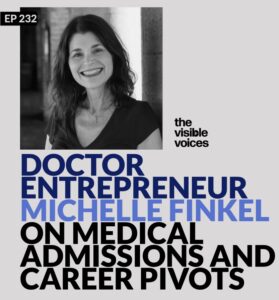
Listen to Dr. Finkel’s interview on The Visible Voices podcast: 


Listen to Dr. Finkel’s interview on the White Coat Investor podcast:

Listen to Dr. Finkel’s interview on the FeminEm podcast: